
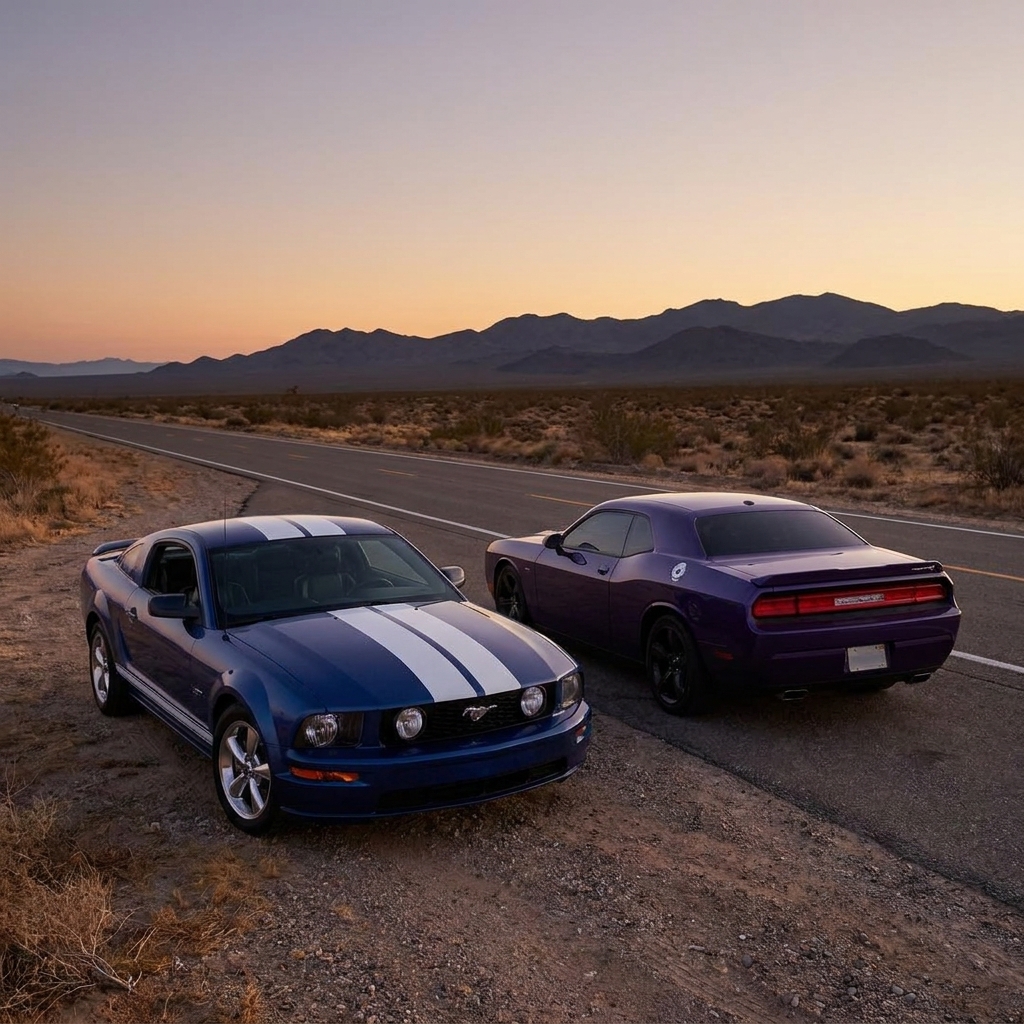
Choosing between a 2009 Mustang GT and Challenger R/T comes down to feel: a lighter 4. 6L V8 coupe vs a bigger, heavier 5. 7L Hemi cruiser.
Most comparisons get stuck on peak horsepower. That’s only part of it. These cars feel different at 30–70 mph, in a parking lot, and on a long freeway run. And at 15+ years old, condition and maintenance history can outweigh any spec sheet.
- Decide first if daily comfort and cabin space matter more than nimble feel.
- Assume traction limits shape real-world acceleration more than advertised power.
- Budget time for inspection. Mods and deferred maintenance are common.
How the 2009 Mustang GT vs Challenger R/T comparison usually plays out
Most buyers end up choosing between two personalities, not two numbers. The 2009 Ford Mustang GT (S197) is the more compact package. The 2009 Dodge Challenger R/T (LC) brings more size, more wheelbase, and a more relaxed cruising vibe.
Both are traditional front-engine, rear-wheel-drive V8 coupes offered with manual and automatic transmissions. Both respond to bolt-ons. Both can be great, or a headache, depending on prior ownership.
Three anchors keep the comparison grounded.
- Mass and size: the Challenger carries more weight and footprint; the Mustang feels smaller on the road.
- Power delivery: 4.6L 3-valve V8 character versus 5.7L Hemi torque feel.
- Use pattern: commuter comfort, weekend backroads, or straight-line runs ask different things.
That’s the frame. Everything else hangs off it.
Quick reality check: What counts as "fast" and "fun" in 2009
In this era, both cars sit in the same broad performance neighborhood. Stock-for-stock, neither is a modern 2024 Mustang GT vs Challenger Scat Pack kind of problem. Tires, road surface, and driver inputs matter more than forum arguments.
Start with the parts that shape the seat-of-the-pants feel.
- Traction: with rear-wheel drive and factory all-season tires on many used examples, wheelspin can dominate 0–30 mph.
- Gearing and shifting: manuals reward clean launches; older automatics can feel soft on kickdown unless tuned.
- Midrange: the Challenger’s 5.7L tends to feel fuller at light throttle; the Mustang’s 4.6L likes revs.
Don’t over-read a single drag-strip story. A 2009 Challenger R/T vs 2009 Mustang GT race can flip on tire condition, ambient temperature, and whether one car is carrying a passenger and a trunk full of tools.
One more point gets missed. At this age, "fast" often means "healthy." A car down 30–40 horsepower from neglect won’t announce it with a warning light. It just feels flat.
What actually drives the choice: Daily livability vs weekend intent
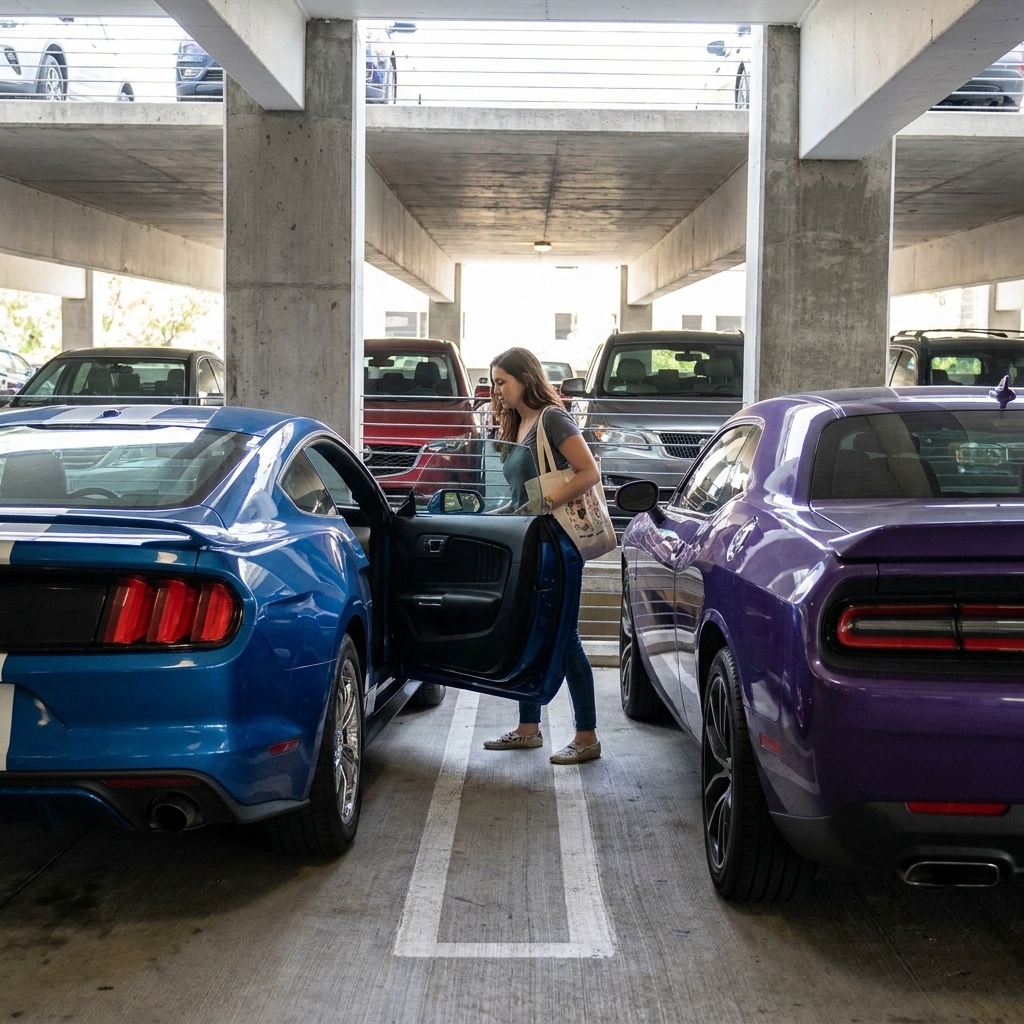
Most owners live with these cars in ordinary moments. Visibility pulling out of a driveway. Getting in and out in a tight garage. Cabin noise at 70 mph. Those details decide long-term satisfaction more than the badge.
The Challenger’s size pays off in a few places. The cabin generally feels wider, and the longer wheelbase tends to calm the ride on rough highways. It can feel like a muscle coupe that’s comfortable doing distance.
The Mustang counters with a smaller footprint that’s easier to place. Parking, quick lane changes, and narrow roads tend to feel less like work. It’s also easier to find in manual form, and the aftermarket support for the S197 is deep.
Two questions sharpen the decision early.
Is this a daily driver with real errands?
If yes, small annoyances matter. Check seat comfort, pedal placement, and sightlines. Pay attention to steering effort at low speed and how the car behaves in stop-and-go with the air conditioning on.
Or is it a weekend car with a single mission?
If the goal is straight-line acceleration, consistency matters. Heat soak, tire width, and differential health show up quickly. If the goal is backroad pace, brake feel and front-end response matter more than peak torque.
That’s also where the "05 09 Mustang GT vs Challenger R/T" discussions get misleading. The Mustang platform spans multiple years with small changes, and the Challenger’s options and prior modifications can vary a lot car to car.
Year-specific context: Why 2009 matters for both platforms
Model-year context keeps expectations realistic. A 2009 Mustang GT sits in the pre-Coyote era. It uses the 4.6L 3-valve V8, and it predates the 2011+ 5.0L jump that changes the whole Mustang conversation. People comparing a 2011 Dodge Challenger R/T vs Mustang GT are often thinking about a different Mustang engine entirely.
The 2009 Challenger R/T is early in the modern Challenger run. It has the 5.7L Hemi, and many buyers cross-shop it against the Mustang GT because both deliver the classic V8 layout without stepping into the higher-cost SRT territory.
That leads to a common confusion point: cross-year comparisons like 2010 Challenger R/T vs Mustang GT or 2010 Mustang GT vs Challenger SRT8. Those can be useful, but they are not the same problem as a clean 2009-to-2009 match. The SRT8 adds a different power and brake baseline, and later Mustang engines shift the balance again.
Keep the scope tight. Compare the cars in front of you, in their condition, with their paperwork.
How the powertrains feel in real driving: 4.6L 3V vs 5.7L Hemi
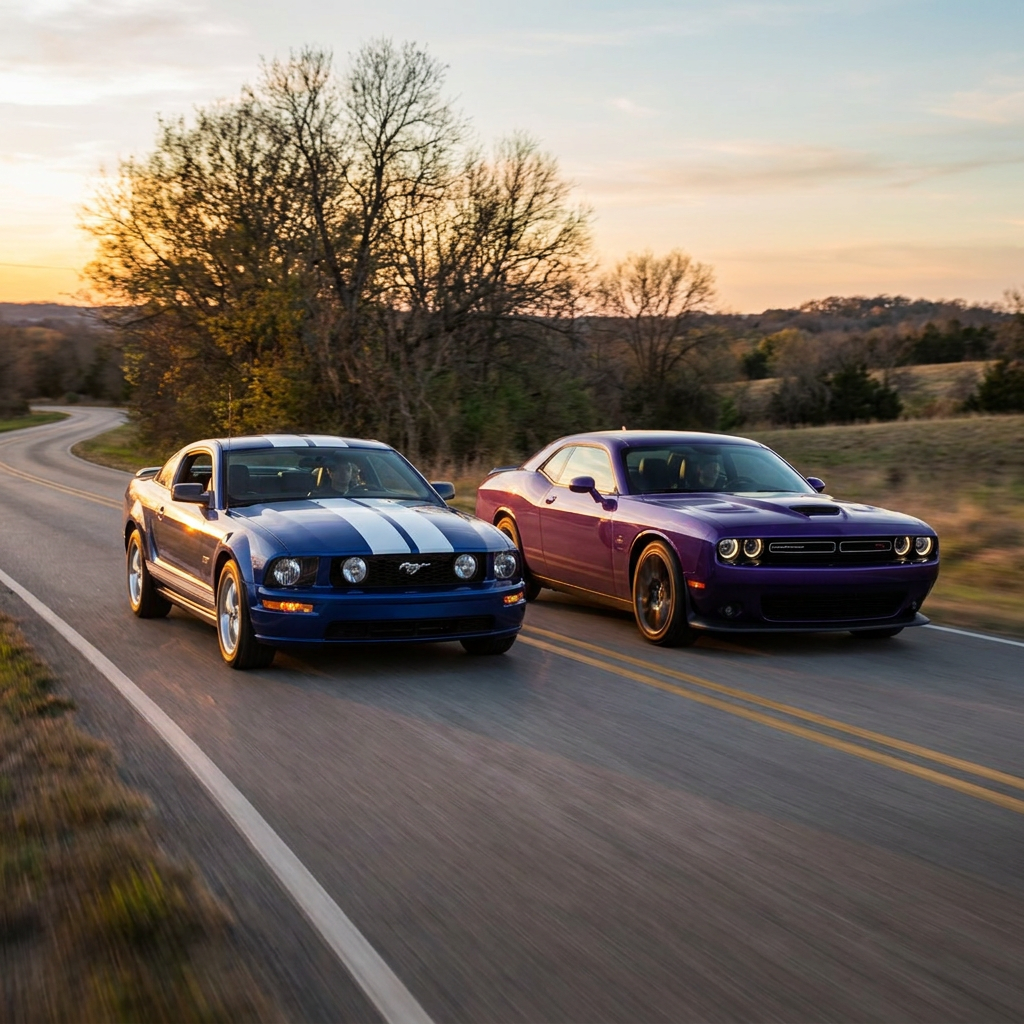
On paper the 2009 Mustang GT and 2009 Challenger R/T sit close enough that arguments turn into trivia. On the road, the engines separate themselves by how they deliver effort, not by a single peak number.
The Mustang’s 4.6L 3-valve V8 rewards revs. It tends to feel more eager as the tach climbs, and it asks for a downshift sooner if the goal is to surge from 40 to 70 mph without waiting. That character suits drivers who like working the shifter and stretching gears. It also means a lazy throttle foot can make the car feel calmer than expected.
The Challenger R/T’s 5.7L Hemi usually feels fuller at light-to-mid throttle. It delivers a more immediate push in everyday passing, even before a downshift. That matters in traffic. It also shapes how the car feels with an automatic, because the transmission can stay in a taller gear more often without the engine feeling flat.
Two real-world details keep coming up on test drives.
- Heat and consistency: repeated pulls on a warm day can soften response on either car, but a neglected cooling system shows up faster than most buyers expect.
- Sound and vibration: the Mustang often communicates more through the cabin at higher rpm; the Challenger’s longer wheelbase and heavier structure can make the drivetrain feel more isolated.
Also, the "healthy engine" check matters more than brand loyalty at this age. A tired ignition system, old plugs, or a dragging brake caliper can erase the difference a spec sheet claims.
For cross-year context, discussions like "2010 Challenger R/T vs Mustang GT" can blur the picture. The driving feel still tracks the same core split, but the individual car’s tune, maintenance, and transmission behavior tend to dominate the experience.
For inspection basics and safety checks, see the NHTSA used-car guidance: https://www.nhtsa.gov/equipment/tires.
Manual vs automatic: Where the same car can feel like two different cars
Transmission choice changes the 2009 Mustang GT vs Challenger R/T comparison more than many buyers admit. Same badge, different behavior.
With a manual, both cars lean on driver skill for smoothness and speed. Clutch engagement, shifter feel, and how the engine responds just off idle decide whether the car feels cooperative in traffic. A worn clutch or tired synchronizers can hide in a short test drive, then become obvious in week two.
With an automatic, the "personality" comes from calibration. Older automatics can feel relaxed on part throttle and then abrupt when kicked down. That’s not always a problem. But it changes how confident the car feels in a quick merge or a two-lane pass.
Pay attention to a few things that don’t show up in a dealership listing.
- Kickdown timing at 30–50 mph: hesitation can be normal, but a long delay or flare between gears can hint at wear or tuning issues.
- Converter lockup behavior: hunting in steady cruising can feel like a mild surge, and it can be misdiagnosed as an engine problem.
- Shift quality when warm: many transmissions behave fine cold. Ten minutes later, the truth shows up.
A clean manual can make the Mustang feel more involved and the Challenger feel more classic-muscle. A clean automatic can make the Challenger feel effortless and the Mustang feel more like a cruiser than expected.
That’s why forum debates comparing "2010 Mustang GT vs Challenger SRT8" often miss the point for a used buyer. Transmission condition and calibration can outweigh trim badges once mileage and age enter the picture.
Chassis and braking: How weight changes the whole conversation
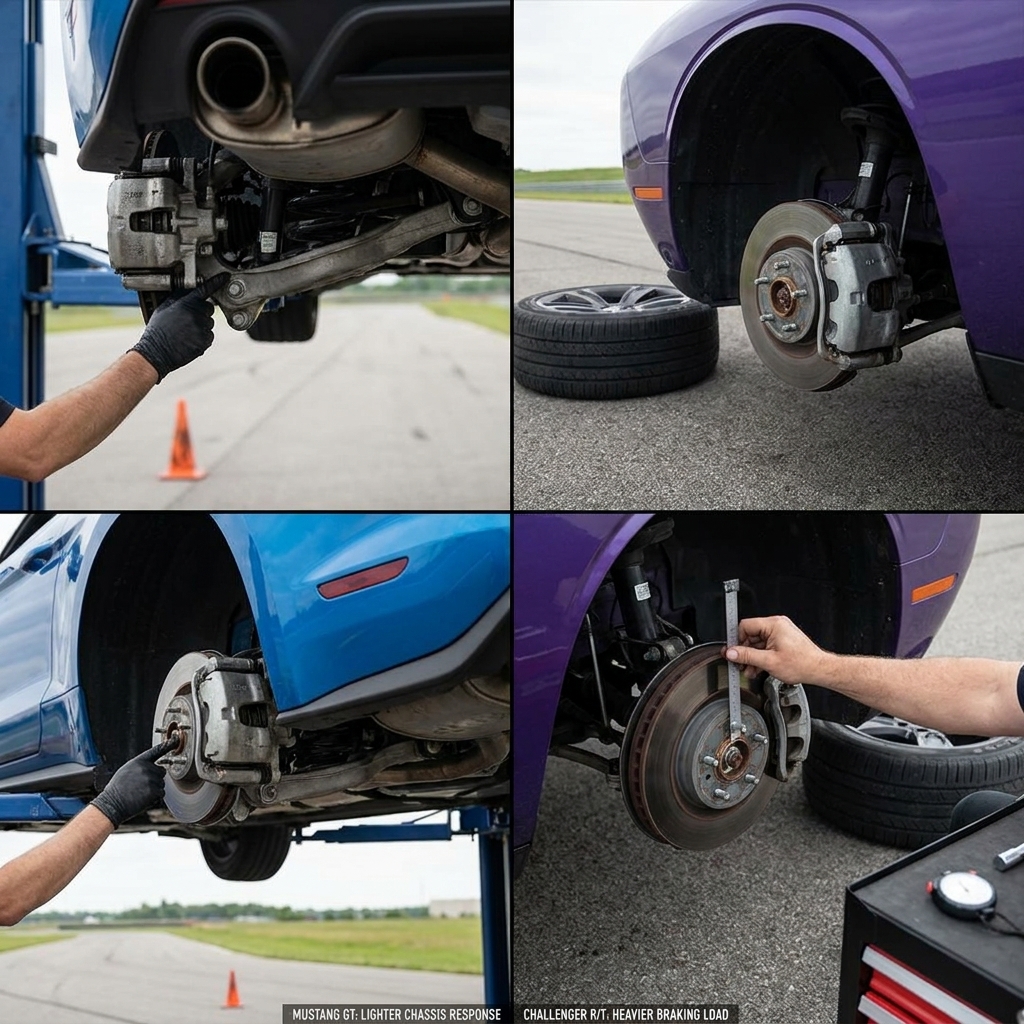
Weight is the quiet variable that keeps deciding this matchup. A 2009 Dodge Challenger R/T is typically hundreds of pounds heavier than a 2009 Ford Mustang GT. That mass shows up in transitions, braking feel, and how quickly the front end responds to small steering inputs.
In normal driving, the heavier car can feel planted and calm. On rough highways, it can also feel less busy. But when the road tightens, extra weight asks more from the front tires and front brakes. That can make the Challenger feel like it prefers smooth arcs over quick direction changes.
The Mustang’s smaller footprint and lower mass tend to make it easier to place on a narrow road. It can feel more willing to rotate with a lift of the throttle. That same trait can also make it feel more sensitive to mid-corner bumps or uneven pavement. Suspension condition matters a lot here. Worn shocks, tired bushings, and mismatched tires can turn "nimble" into "nervous."
Brakes deserve their own sanity check. A 15+ year-old performance coupe can have plenty of pad left and still stop poorly because of old fluid, glazed pads, or warped rotors.
- Brake pedal feel: a long, soft pedal often points to fluid age or air, not just pad wear.
- Steering shake under braking: can be rotors, but also tired front-end parts that allow movement under load.
- One-sided pull: can be tire mismatch, alignment, or a sticky caliper.
None of this picks a "winner." It just clarifies why two cars with similar straight-line reputation can feel far apart when driven back-to-back on imperfect roads.
Ownership risk and reliability: What tends to cost time and money on 2009-era cars
Reliability talk in a Mustang GT vs Challenger R/T reliability thread often turns into brand stereotypes. Used-car reality is more boring. Maintenance history and prior modifications usually decide the experience.
Start with age-driven wear that hits both platforms. Rubber hardens. Fluids get ignored. Electrical grounds corrode. A car can look clean and still be behind on basics. Plan on catching up unless there’s proof it was done recently.
A practical time horizon helps. Over the first 30 days of ownership, issues that were masked by a short test drive tend to surface: intermittent misfires under load, cooling fans that only fail in traffic, and suspension clunks that appear on driveway angles. Over 6–12 months, the bigger costs show up: tires, brakes, and suspension refresh work that restores the car’s original feel.
Two patterns deserve extra attention because they change the "cheap fun" math.
- Modified cars: intake, exhaust, tuning, and lowered suspension can be fine when done cleanly. Stacked mods without documentation can create drivability quirks that are hard to chase.
- Deferred cooling and driveline service: old coolant, tired belts, ignored differential fluid, and worn mounts often don’t strand the car immediately. They steadily erode confidence.
Paperwork matters more than stories. Look for dated receipts, not just verbal claims. And if the comparison shifts to later trims like "2012 Challenger SRT8 vs Mustang GT," keep the reliability lens the same. More performance hardware can mean more expensive wear items, but condition still leads the outcome.
Used-market reality check: How to test-drive and inspect a 2009 Mustang GT or Challenger R/T
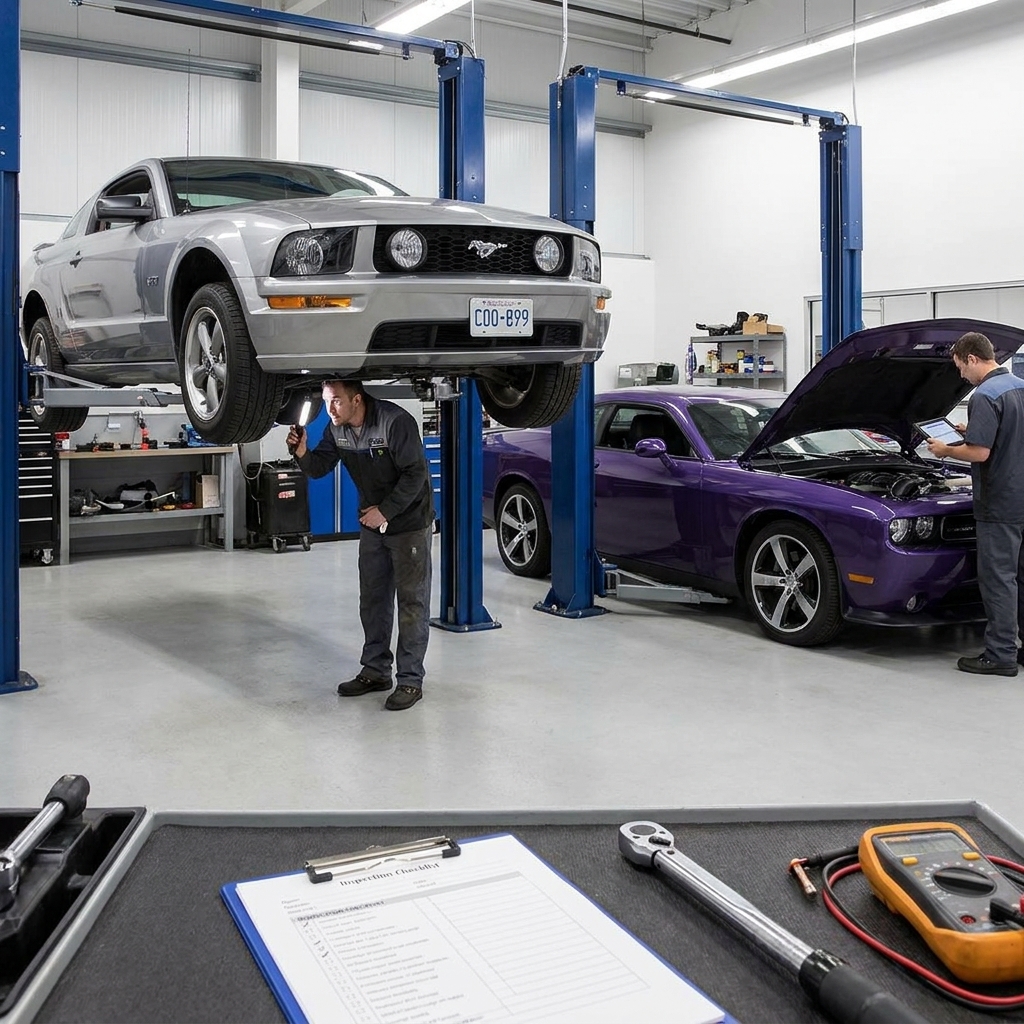
For a 2009 Mustang GT vs Challenger R/T purchase, the most expensive mistake is treating a clean-looking car like a known-good car. At 15+ years old, small clues tell the story: how it starts hot, how it behaves after 20 minutes in traffic, and whether the chassis feels tight over broken pavement.
A test drive should include at least 25–30 minutes and both stop-and-go and steady cruising. Keep the radio off. Windows up for wind noise, then down for drivetrain sounds. And don’t accept "it just needs a tune" as an explanation for roughness, surging, or warning lights.
Use a simple script that works on both coupes.
- Cold start behavior: listen for a brief rattle versus sustained noise, and check for misfire feel in the first minute.
- Idle and accessories: turn on air conditioning at idle and watch for dips, hunting, or stalling tendencies.
- Part-throttle pull: hold 1,500–2,500 rpm in a higher gear and feel for smoothness. Jerks can point to tuning or ignition issues.
- Wide-open throttle once: one clean pull is enough. Watch temperature and listen for pinging under load.
- Brake check: one firm stop from about 60 mph should feel straight and consistent. Pulsation and steering shake need an explanation.
- Steering and front-end check: at 30–40 mph, lightly weave within the lane. Wandering or clunks suggest worn components or alignment issues.
- Parking-lot check: full-lock turns both directions can reveal groans, binding, or CV-like clicking sounds from neglected front-end parts.
- Heat soak: after the drive, let it idle for 5 minutes. Fans should cycle normally without creeping toward hot.
Paperwork is part of inspection, not an afterthought. Look for dated receipts for fluids, brake work, tires, and cooling service. A folder with gaps is normal. A seller who can’t name the last time the differential fluid or brake fluid was changed is a risk signal.
Modified examples deserve a tighter standard, not a looser one. Clean wiring, a coherent parts list, and a tune from a known shop matter more than the number of bolt-ons. If the car is lowered, check tire wear inside edges and listen for suspension contact over bumps.
Where this fits: Choosing between Mustang GT and Challenger R/T without forcing a winner
The 2009 Mustang GT tends to fit drivers who want a smaller-feeling coupe that rewards involvement. It suits narrow roads, tighter parking, and owners who enjoy manual shifting and a more direct sense of what the front tires are doing. It also fits buyers who plan to tinker, because the S197 ecosystem is deep and parts knowledge is everywhere. Expect to notice road texture. That’s part of the point.
The 2009 Challenger R/T tends to fit drivers who want a bigger cabin, a calmer highway rhythm, and a more relaxed muscle-coupe feel day to day. It matches long commutes, frequent passengers, and buyers who care about a substantial ride more than quick direction changes. The footprint asks for more space at home and more patience in tight lots. But for distance driving, that extra mass can feel like a benefit, not a drawback.
A compact trade-off map for 2009 Mustang GT vs Challenger R/T choices
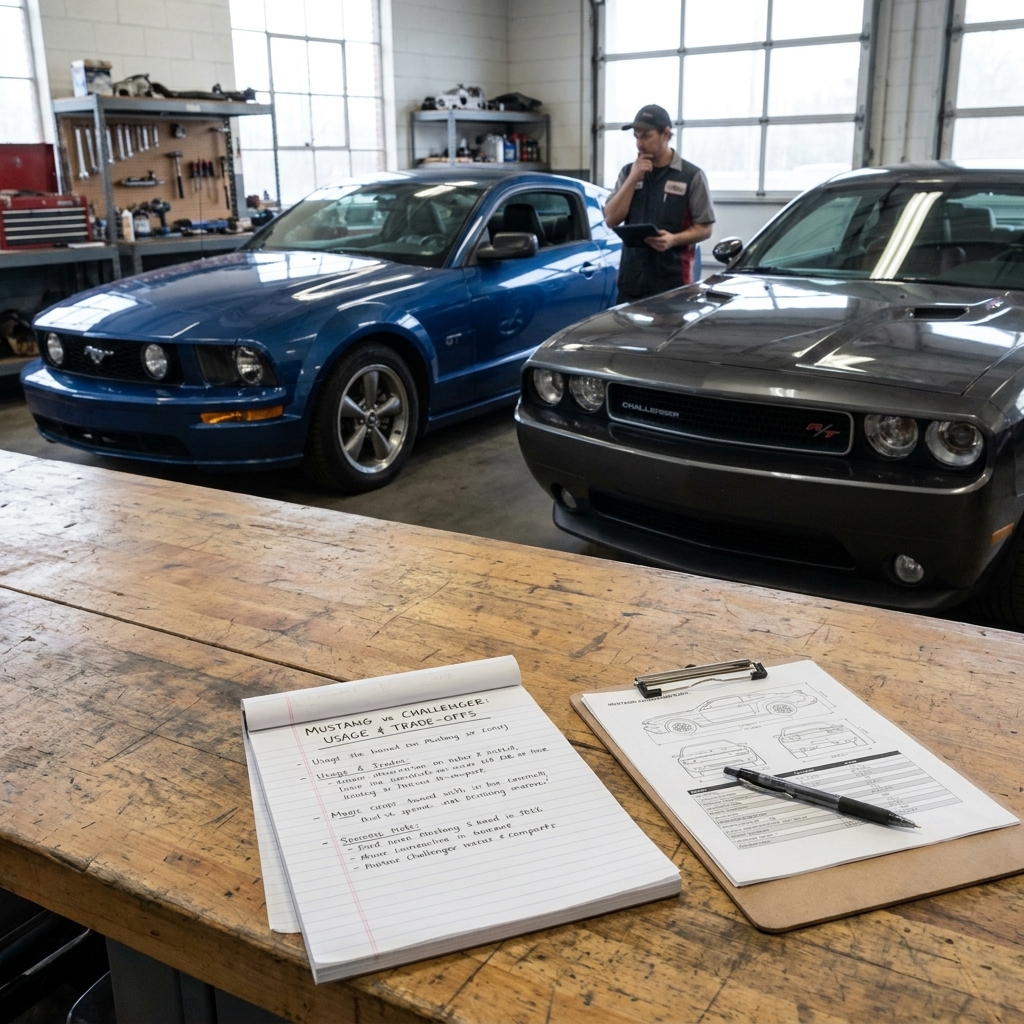
Some decisions get easier when the trade-offs are written down in plain language. This isn’t a scorecard. It’s a way to stop chasing one perfect answer when the real question is how the car will be used.
| Situation | Leans Toward | Reason It Matters |
|---|---|---|
| Tight parking, narrow roads, frequent short trips | 2009 Mustang GT | Smaller footprint feels easier to place and less like work. |
| Long highway runs, passengers, relaxed cruising | 2009 Challenger R/T | Size and wheelbase favor steadiness and cabin space. |
| Driver wants an involved manual feel | 2009 Mustang GT | More "work the drivetrain" character rewards shifting and revs. |
| Driver wants easy passing without chasing gears | 2009 Challenger R/T | Stronger light-to-mid throttle shove suits everyday traffic. |
| Backroad pace on imperfect pavement | Depends on condition | Suspension health and tire match can outweigh platform differences. |
| Buying a modified car | Either, with documentation | Receipts and a coherent build matter more than brand stereotypes. |
A clear editorial position helps at this point. When two used cars feel close on a quick drive, the safer long-term bet is the one that feels mechanically "tight" and comes with better records, even if it isn’t the preferred badge. A healthy car stays fun. A neglected one turns every drive into diagnosis.
Cross-year phrases like "2010 Challenger R/T vs Mustang GT" show up a lot in searches, but they don’t change the practical logic here. Condition, transmission behavior, and how the car fits the daily routine decide satisfaction more than model-year trivia.
Affiliate links aren’t useful for used cars. But for simple display or desk reference, a small model can be a harmless way to keep the shape in mind: KiNSMART 2006 Ford Mustang GT 1:38 Scale 5" Die Cast Metal Model Toy Car (Blue Race).
Common questions
In "2009 Mustang GT vs Challenger R/T," how much does mileage really matter?
It matters, but not as a single number. Service history, how it drives when fully warm, and evidence of consistent maintenance usually predict ownership cost better than the odometer alone.
Is it smart to buy one that’s already modified?
Yes, if the modifications look coherent and documented. Avoid cars with stacked changes and no receipts, because drivability quirks can become time-consuming to sort.
For a daily driver, what’s the quickest way to spot a bad example?
Drive it long enough to heat-soak it and include stop-and-go. Rough idle with air conditioning on, overheating in traffic, and inconsistent shifting when warm are strong reasons to walk away.
Does a manual or automatic change the decision more than people think?
Often, yes. A healthy manual can make either car feel sharper and more predictable, while a tired automatic can make a strong engine feel lazy or inconsistent in real traffic.
Three things worth remembering
2009 Mustang GT and 2009 Challenger R/T fit different daily routines, so the "right" choice is use-pattern dependent.
Condition and documentation are the real performance upgrade on 15+ year-old cars.
Choose the car that feels tight, consistent, and confidence-inspiring when fully warm.