

Camaro vs Mustang vs Dodge comes down to body style, engines (V6/V8), and intent: daily usability, handling feel, or straight-line muscle.
The question "Camaro X Mustang Vs Dodge" is rarely just a horsepower contest. It’s usually a quick way to clarify three things: the driving experience you want (more communicative vs more “muscular”), how much everyday practicality you need, and which exact trim you’re comparing (because these names cover very different families).
- First, clarify whether “Dodge” means Challenger (coupe) or Charger (sedan): it changes space, visibility, and day-to-day use.
- Compare like-for-like powertrains and drivetrains (V6 vs V6, V8 vs V8; RWD vs RWD) to avoid misleading conclusions.
- The decision often comes down to ergonomics, perceived quality, and running costs (tires, brakes, insurance), not just acceleration.
How to read “Camaro X Mustang Vs Dodge” without getting confused
It helps to treat this as a comparison between three modern muscle-car philosophies: Chevrolet Camaro, Ford Mustang, and the Dodge world—which is effectively at least two cars (Challenger and Charger). Camaro and Mustang are sporty coupes; Dodge can be a big coupe (Challenger) or a high-performance sedan (Charger). That alone explains why many online debates sound like people are talking about different cars.
A second common mistake is mixing power levels: an entry trim versus a “halo” trim makes for dramatic numbers but a bad decision. The right way to read it is by engine families: six cylinders as the entry point, eight cylinders as the identity core, and track-leaning or straight-line packages as specializations.
Third: drivetrain and torque management. A big part of the real-road experience depends on how easily the car puts power down and how it communicates the limit. This rarely shows up in a spec sheet, but it matters a lot day to day.
Quick orientation, without turning it into a ranking:
- Camaro is often seen as the most “sporty” in chassis feel and precision, but it can demand visibility compromises.
- Mustang often balances performance and usability, with a more “grand touring” personality depending on trim.
- Dodge leans into character and presence: size, big-American comfort, and engines that favor torque and straight-line ease.
Dodge: when people mean Challenger vs when they mean Charger
Saying “Dodge” in a Camaro X Mustang Vs Dodge comparison is incomplete. Challenger and Charger share an image, but they serve different needs. Challenger is the natural format rival to Camaro and Mustang: coupe, long hood, more traditional vibe. Charger changes the rules: four doors and a more performance-sedan setup.
This isn’t just a forum detail—it changes how you live with the car. A sedan can offer more sensible rear access, easier loading for bulky items, and a more “do-it-all” role without abandoning the muscle-car theme. A big coupe can deliver more atmosphere and a different sense of front-seat space, but often with proportions that feel more massive in parking lots and narrow streets.
Two practical questions help avoid the basic mistake:
Does “Dodge” mean a daily driver or a weekend car?
If the idea is daily use with rear passengers, “Dodge” usually points toward Charger. If the idea is the classic American coupe as an emotional object, Challenger is the more coherent reference.
Are you comparing the same power band?
Keep the comparison consistent: V8 vs V8, six-cylinder vs six-cylinder. Otherwise you end up debating identity, not making a concrete choice.
One last point that’s often ignored: size and mass also affect fuel use, tire and brake wear, and overall cost per mile. It’s not a “flaw” by itself; it’s a constraint to put on the table before falling in love with a spec sheet.
What changes between Camaro, Mustang, and Dodge in real-road driving

Real driving isn’t a track test or endless stoplight launches. It’s rough pavement, traffic, variable-radius corners, passing, and slow maneuvers. In a Camaro X Mustang Vs Dodge comparison, the most tangible differences come from three areas: visibility and seating position, front-end behavior, and how the car puts power down.
Visibility: modern coupes with high beltlines and small windows can look dramatic outside and feel more “closed in” inside. That affects parking fatigue and city confidence. It’s common for a car that feels more sporty to demand more attention in lane changes or roundabouts simply because you see less. Here, sitting in the driver’s seat matters more than ten reviews.
Steering and front-end communication: some setups prioritize immediacy and precision, others stability and a “planted” feel. In practice, back-road drivers may prefer a front end that turns in with less inertia; highway commuters may appreciate a calmer, more stable car at speed.
Traction and torque: as power rises, the difference isn’t only “how fast,” but how often you can use that force. With lots of torque, the car can become more demanding on cold or wet asphalt. That shifts the decision toward tires, traction control, and throttle calibration. It’s also why two cars with similar numbers can feel very different in everyday drivability.
Three useful numeric anchors, without getting hypnotized by records:
- A modern muscle car can easily exceed 300 hp in many configurations—think about where you’ll actually use it.
- With 18–20 inch wheels, tire costs change a lot and the car becomes more sensitive to potholes.
- Overall mass (often over 1,600 kg in many trims) affects braking and fuel use more than the “engine spec” alone.
One detail worth attention: transmission and gearing. Even with the same engine, shorter gearing makes the car feel more reactive at low speeds; taller gearing can feel calmer, with less noise at cruise. You’ll feel this immediately on a test drive, and it often matters more than the headline horsepower figure.
Cabin and practicality: where daily use really changes
In a Camaro X Mustang Vs Dodge comparison, many choices flip when you move from “I like it” to “I live with it.” Not as moralizing—just because these cars have different design compromises. The same power can be fun or tiring depending on entry/exit, maneuver visibility, and how much space remains for people and stuff.
Camaro and Mustang are coupes that require some tolerance for rear-seat access and a more snug environment. Challenger, while still a coupe, tends to feel more “open” up front; Charger adds four doors and shifts the whole discussion—it becomes more credible as a family car without dropping the muscle-car theme.
Three practical details matter more than most spec-sheet debates admit:
- Footprint and perceived maneuverability: a long, wide car isn’t only “imposing”; in the city it means more corrections, more curb awareness, and more stress in tight garages with steep ramps.
- Trunk and loading opening: nominal volume matters less than shape. A narrow opening or high lip makes bulky items awkward even if they “fit” on paper.
- Noise and comfort: suspension tuning, wide tires, and a louder exhaust can be great on weekends and tiring on repeat commutes. Road surface matters too—on broken pavement, comfort becomes a decision factor, not a luxury.
A useful numeric anchor for real life: with 18–20 inch wheels, tire sidewall shrinks and the car becomes more sensitive to potholes and expansion joints; the same road you’d ignore in a “normal” car demands more care here. It’s not an absolute defect—it’s the price for looks and grip.
One less-obvious note on tech: it’s not only “which screen” or “how many speakers,” but control ergonomics. In a low seating position with limited visibility, a confusing interface or tiny buttons increase fatigue. It rarely shows up in quick comparisons, but you feel it after 30–40 minutes of traffic.
Running costs and wear: what changes your mind after 12 months

People searching Camaro X Mustang Vs Dodge often focus on acceleration and “character,” then discover the real constraint is cost per mile. It’s not just fuel—it’s the sum of components that work harder and wear faster on powerful, heavy cars.
The items that most change ownership, especially as power and wheel size go up:
- Tires: wider sections and performance compounds mean more grip, but also more temperature sensitivity and wear. In stop-and-go urban use, consumption can accelerate noticeably.
- Brakes: more mass and higher average speeds mean more energy to shed. Spirited mountain driving increases pad wear and thermal stress; steady highway cruising is gentler.
- Insurance: power, value, and model profile affect quotes. Don’t assume two “similar” V8s cost the same to insure—classification varies widely by market and insurer.
- Fuel: no need to invent absolute numbers; just remember a V8 used in the city is rarely “reasonable,” and your right foot matters more than the brochure.
One source of confusion: the gap between “theoretical” cost and “behavior” cost. A big engine can drink even when driven gently, but it’s often the combination of torque, wide tires, and traffic that pushes spending up. If the car lives on ring roads and highways, the picture changes; if it lives between lights and parking lots, it changes again.
Another underestimated factor is modifications. Many owners enter the muscle-car world planning to “fix it later” with exhaust, suspension, or wheels. It can improve enjoyment, but it often worsens comfort, compliance, and insurance relationships. In practice, the car becomes more specialized and less easy to use every day.
Safety and driver assistance: what to look for and what to expect
In a Camaro X Mustang Vs Dodge comparison, safety isn’t a “brochure chapter”—it’s a set of concrete choices that change day-to-day peace of mind. The typical confusion is twofold: some assume “muscle car” automatically means few aids; others assume electronics solve everything. Neither view helps.
The most sensible way to evaluate it is by functions and system coherence, not by the presence of a single acronym. In particular:
- Automatic braking and alerts: especially useful in the city, where visibility can be limited by high beltlines and thick pillars.
- Traction and stability control: on high-torque RWD cars, calibration is the difference between “teaching” intervention and overly aggressive power cuts that ruin the drive.
- Cameras and sensors: not a frivolous extra when the rear deck is high and rear visibility is limited; they reduce low-speed bumps and parking stress.
- Headlights: beam quality and high-beam management matter on rural roads, where these cars are often driven for enjoyment.
To avoid abstract debates, anchor to verifiable standards. In Europe, driver-assistance systems sit within a regulatory approval framework under UNECE regulations; for example, the general framework for steering equipment and related functions is tied to UNECE Regulation No. 79, available via the official UNECE WP.29 regulations collection (official UNECE vehicle regulations collection).
The most practical takeaway is this: on any specific car, verify packages and equipment, because availability changes by model year and trim. Two cars that look identical at a glance can differ hugely in AEB, lane support, sensors, and cameras. In daily life, those differences can matter more than a second in 0–60.
Perceived reliability, longevity, and buying used: how to avoid misleading comparisons
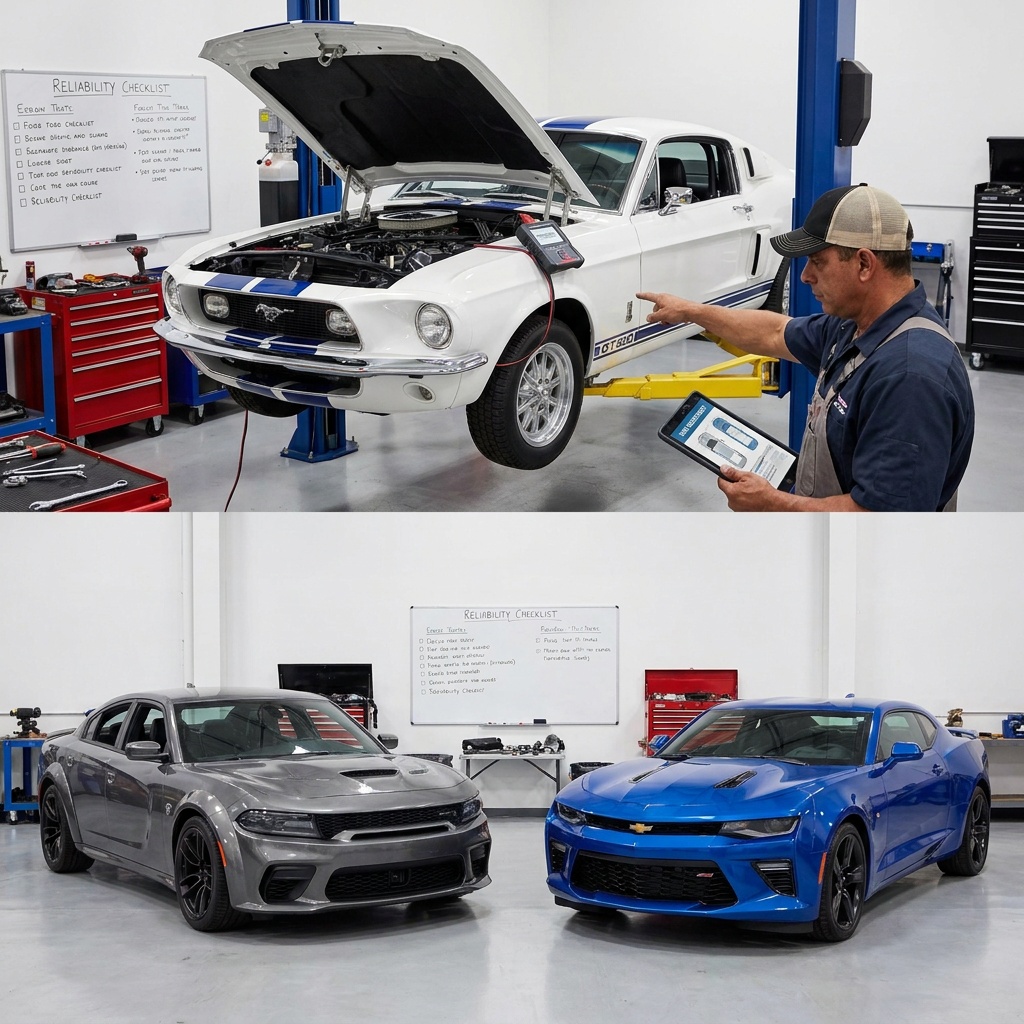
When people talk Camaro X Mustang Vs Dodge, reliability often gets reduced to slogans. It’s more useful to think in risk areas and in how well the car’s mechanical setup matches its past and future use—especially when buying used.
A simple rule: the more extreme the trim (power, cooling, brakes, tires), the more it depends on correct maintenance and prior use. That doesn’t mean it “breaks”; it means it tolerates neglect less. A highway-only owner may have a better-lived car than someone who did lots of stop-and-go with constant launches and braking, even at the same mileage.
A realistic timeline helps set expectations: within 6–12 months after a used purchase, “hidden” costs often surface if history wasn’t checked carefully. It’s not only failures; a series of small items (tires, brakes, alignment out of spec, weak batteries) adds up and changes satisfaction.
To keep the inspection concrete without turning it into an endless list, focus on five points that separate a good example from a tired one:
- Documented service history: scheduled maintenance, recalls completed, brake and tire work. Missing proof isn’t a conviction, but it should affect price and expectations.
- Wear consistent with mileage: steering wheel, driver seat, pedals. If the cabin tells a longer story than the odometer, the mechanicals often worked harder too.
- Suspension and alignment: pulling or uneven tire wear can hide impacts, geometry issues, or cheap replacement parts.
- Temperature and cooling under load: on higher-output trims, a marginal system shows up in climbs, summer heat, and traffic. The gauge or warning light shouldn’t become “normal.”
- Undeclared modifications: exhausts, tunes, intakes, suspension. Some are done well, some aren’t; either way they affect reliability, legality, and resale.
A specific note on Dodge, because in a Camaro X Mustang Vs Dodge comparison the word “Dodge” covers two different cars: in the used market, Charger vs Challenger can also differ in prior use. A sedan may have done more “service” or family miles; a coupe may have seen more recreational use. Not a rule—just a useful starting hypothesis when reading the car’s signs.
The choice comes down to one trade-off: precision, balance, or presence
In a Camaro X Mustang Vs Dodge comparison, the most common mistake is hunting for a universal verdict and then trying to “fix it” with a trim. It works the other way around: start from the trade-off you’re happy to accept. If you want a car that invites good driving even when the road isn’t perfect, prioritize precision and chassis coherence; if you want a compromise that doesn’t turn every outing into a tolerance test, balance and ease matter; if impact, big-American feel, and how the car occupies the road are the point, the choice shifts toward “presence” and perceived torque.
A practical rule that beats many debates: if you’re tired after 20 minutes of traffic, the choice is already wrong even if it’s “faster” on paper. This is where Camaro, Mustang, and Dodge separate by character before numbers. Camaro tends to reward drivers who want a tighter, more focused feel; Mustang is often the most livable middle ground as a mindset, not just a size; Dodge—whether Challenger or Charger—centers a broader, more theatrical experience. Not a ranking: a way to avoid buying an idea and ending up with a constraint.
Editorial stance, plainly: if you want one car that can also handle normal life without making you want to “swap it in a year,” the most coherent choice usually points to Mustang or the Dodge Charger; Camaro makes more sense when the use is intentionally more dedicated and you accept that some compromises aren’t negotiable.
Camaro X Mustang Vs Dodge: a decision shortcut to match car and use

When the Camaro X Mustang Vs Dodge comparison gets real, you need a quick map that doesn’t mix up format and expectations. It won’t replace a test drive, but it helps you avoid looking at the “wrong” car for two weeks.
| Situazione Reale | Opzione Che Di Solito Ha Più Senso | Perché |
|---|---|---|
| Auto unica, uso frequente, città + tangenziale | Ford Mustang o Dodge Charger | Più facile convivere con accesso, visibilità e praticità senza perdere il carattere |
| Weekend, strade guidate, piacere di traiettoria | Chevrolet Camaro | Impostazione più "sportiva" come sensazione, a patto di accettare compromessi |
| Atmosfera muscle tradizionale, coupé grande, guida rilassata | Dodge Challenger | Presenza e comfort percepito davanti, con ingombri che si sentono |
| Uso con passeggeri dietro senza rinunciare al tema | Dodge Charger | Quattro porte e accesso più sensato cambiano la vita quotidiana |
| Si vuole un equilibrio tra divertimento e fruibilità | Ford Mustang | Spesso più "centrata" come compromesso complessivo tra carattere e gestione |
This table only works if you keep the comparison within the same “family”: same engine type, same drivetrain layout, and realistic expectations for tires and brakes. If you compare an extreme trim to a calmer one, the decision becomes a definitions contest, not a use-case choice. And “Dodge” should always be translated into Challenger or Charger—otherwise you end up debating two different cars without noticing.
When this choice fits—and when it becomes a hassle
This trio makes sense for drivers who want a car with a clear identity and accept that part of the value is in how it drives and feels, not just the commute. It works well when your use includes open roads, when size isn’t a daily problem, and when you’re willing to plan for tire and brake management as normal maintenance, not a surprise.
It becomes a hassle if your life is tight parking, steep ramps, and constant traffic, or if you want running costs to be “invisible.” It’s also a poor fit if you plan to constantly change suspension and exhaust without thinking about compliance, insurance, and resale: the risk is a more nervous, less sellable car without a proportional real-world gain.
Frequently asked questions

In a Camaro X Mustang Vs Dodge comparison, which car does “Dodge” actually mean?
It depends on who’s talking: often they mean Challenger, but many daily needs point to Charger. Clarifying it upfront avoids comparing a coupe to a sedan as if they were equivalent.
Does it make sense to choose based on “who’s faster”?
Only if that’s truly your use case and you’re comparing comparable trims. In normal driving, what matters more is how much power you can use calmly—and how tiring the car is in traffic, maneuvers, and rough pavement.
What’s the mistake that most often leads to buyer’s remorse?
Confusing the idea of the car with the life it has to live: size, visibility, and practicality get discovered late, after the initial excitement fades. The second mistake is comparing far-apart trims and expecting the same running costs.
Why do so many online comparisons seem to contradict each other?
Because they mix model years, engines, and packages without stating it, and because many judgments come from personal preference (precision vs presence) rather than objective flaws. Without specifying which Camaro, which Mustang, and which Dodge, conclusions don’t transfer.
Three things that matter most if the choice has to hold up over time
Matching body style to real life matters more than any isolated number: Challenger and Charger aren’t interchangeable just because they share a badge.
The trade-off you’re happy to accept (precision, balance, presence) is the most reliable way to choose between Camaro, Mustang, and Dodge without regret.
A sensible comparison starts with like-for-like engines and layouts: when you mix distant trims, you’re choosing a story, not a car.