
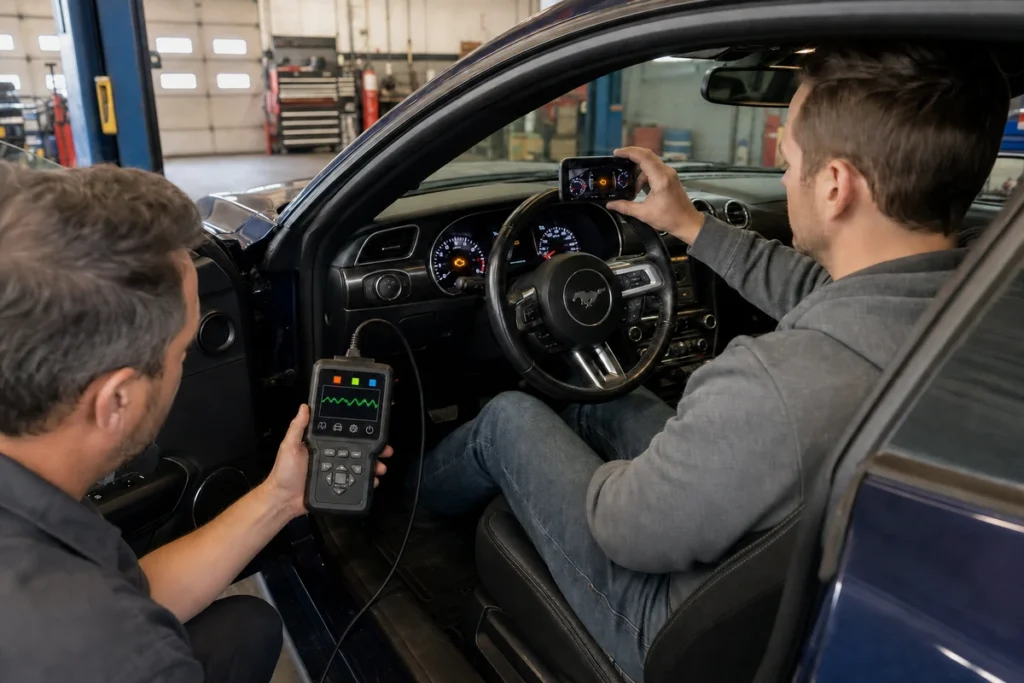
The most valuable minute after a Mustang turns on its check-engine light often happens before anyone reaches for a wrench. The car is still in the condition that triggered the warning: the engine is warm or cold, the fuel level is known, the weather is fresh in memory, and the driver can say exactly what changed. Clearing the light at that moment may make the dashboard look calmer, but it also removes the easiest version of the story to document.
The EPA explanation of on-board diagnostics describes the light and stored diagnostic trouble code as a service alert from the vehicle’s monitoring system. That is the right starting point for a Mustang owner: the lamp means the car detected a condition that deserves attention. It is not, by itself, a receipt for one failed part.
The lamp sets the urgency, not the repair
First decide whether the car should keep moving. A steady lamp with normal gauges and no obvious change in the way the engine runs is different from a flashing lamp, overheating, heavy shaking, smoke, a strong fuel smell, or a sudden loss of power. The EPA notes that a flashing light can indicate a severe misfire that may damage the catalytic converter. Reduce speed and seek service promptly; if the Mustang is running badly or showing another serious warning, stop in a safe place and arrange assistance.
With a steady light, resist the temptation to diagnose from an internet list while driving. Check the exact model-year owner’s manual and look for any other warning shown at the same time. A loose fuel cap may be relevant on some cars and conditions, but tightening a cap is not permission to ignore a light that remains on or a Mustang that behaves differently.
Capture the car before changing the evidence
Park safely, leave the car in its current state long enough to make a short record, and photograph the instrument cluster. Note whether the lamp is steady or flashing and whether the engine was cold, warming up, idling, cruising, accelerating, or just refueled when it appeared. Add the odometer, fuel level, outside temperature, recent work, and any sound, smell, vibration, hesitation, or hard starting.
If a scan tool is available, read the codes without erasing them. Save every code exactly, including letters, numbers, pending status, and any freeze-frame or operating-condition screen the tool provides. Photographing the scanner beside the illuminated cluster ties the data to the moment. Do not disconnect the battery merely to turn the lamp off, and do not change several parts before the original condition has been inspected.
| Record | Useful detail | Why it helps |
|---|---|---|
| Warning state | Steady, flashing, or paired with another lamp | Separates routine diagnosis from urgent symptoms |
| Operating moment | Cold start, idle, cruise, acceleration, or refueling | Gives the technician a condition to reproduce |
| Scan result | Exact stored and pending codes, before reset | Preserves the module’s first report |
| Recent change | Battery work, tune, intake, exhaust, fuel, or repair | Shows what changed before the symptom |
| Driver observation | Noise, smell, shake, stumble, heat, or no change | Keeps a code from replacing the actual behavior |
A code is a starting point, not a shopping list
A diagnostic trouble code identifies the system and condition the control module detected. It does not prove that the component named in a code description should be replaced. A lean-condition code, for example, can be connected to several possible causes; a misfire code still needs testing that distinguishes ignition, fuel, mechanical, wiring, and calibration questions. The code makes the next test more focused. It does not make the test unnecessary.
This distinction matters on modified Mustangs. Record the tune, intake, exhaust, injectors, sensors, gearing changes, and any recent return to stock. Do not assume every modification is the cause, but do not hide it from the person diagnosing the car. The useful question is not “Which part does this code name?” It is “What test will confirm why this condition appeared on this exact car?”
Give the shop a timeline it can use
Send the shop the photographs, exact codes, symptom note, modification list, and repair history before the appointment. Ask whether diagnostic time is charged, what the first tests will cover, and whether the shop will contact you before clearing codes or performing work beyond the agreed amount. The FTC’s auto-repair guidance recommends discussing diagnostic charges and obtaining a written estimate that identifies the condition, parts, and anticipated labor.
After the repair, keep the final work order with the original scan record. It should show what was tested, what was repaired, the mileage, and what authorization was given. If the light returns, that before-and-after file is far more useful than the memory that “a code came up once.” The point is not to turn every owner into a technician. It is to preserve the evidence that lets a technician test the right Mustang in the right condition.