
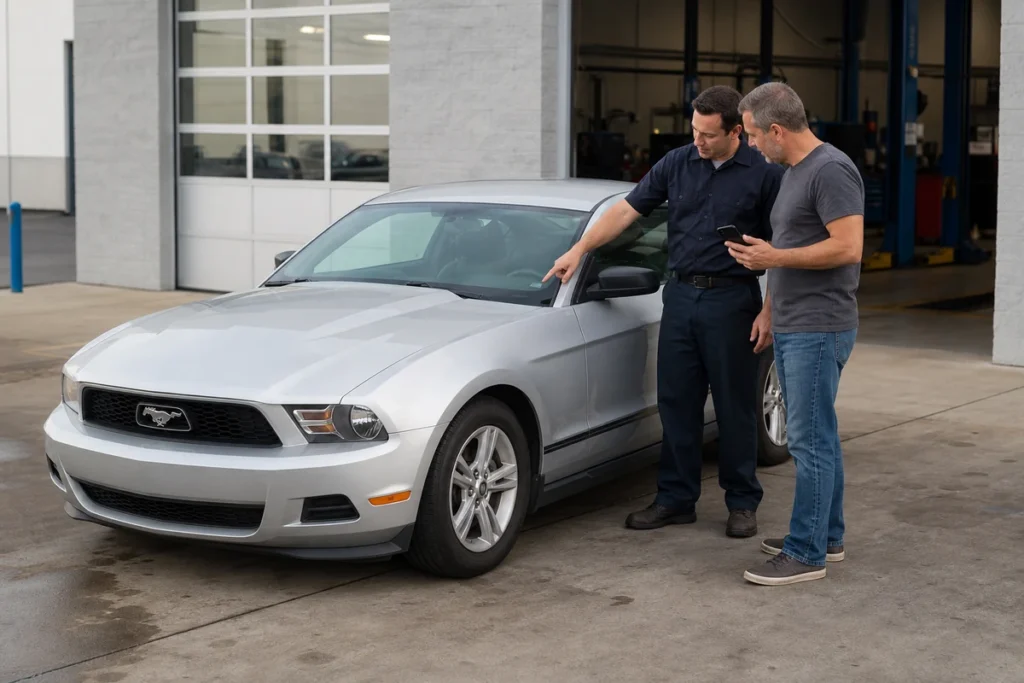
A Mustang can look well cared for, drive normally and still need an urgent safety repair. A seller may honestly say that the car was checked years ago, yet that does not answer the question a buyer or current owner has today. The useful question is narrower: what does this exact VIN show now, what instructions apply, and can a completed repair be proved?
Start with the exact VIN, not a model-year list
The NHTSA recall lookup separates two different searches. A year, make and model search shows general safety information for a group of vehicles. A VIN search tells you whether a specific vehicle has an unrepaired recall in the participating manufacturer data.
Use the full 17-character VIN. NHTSA identifies the lower driver-side corner of the windshield as a common location; the number may also appear on the registration and insurance card. Read it from the vehicle, then compare every character with the document you plan to use. A single transposed letter or number turns a precise check into a result for the wrong car.
At a service lane, ask the advisor to confirm the VIN at the windshield before discussing a campaign or ordering parts. That simple pause connects the database result to the Mustang in front of you. It also prevents a repair history from another car with the same year, color or trim from being treated as evidence for yours.
Read “0 unrepaired recalls” literally
A zero result is useful, but it is not a lifetime safety certificate. NHTSA explains that its VIN result does not show a recall that has already been repaired. It may also omit a recently announced recall while affected VINs are still being identified, recalls more than 15 years old unless the manufacturer offers broader coverage, non-safety customer-service campaigns and recalls conducted outside the United States.
Record the date of the search and the exact VIN used. If you are evaluating a used Mustang, keep that result beside the title and service records rather than relying on a seller’s memory. The result answers “Is an unrepaired safety recall reported for this VIN now?” It does not answer whether every earlier recall was completed correctly or whether the car has unrelated mechanical problems.
Interim instructions matter more than convenience
Not every campaign carries the same urgency. Some notices direct the owner to schedule a normal dealer visit. Others give interim parking or driving instructions. Read the campaign detail before deciding to drive the car to an appointment.
Ford’s 2024 Takata do-not-drive advisory is a clear Mustang example. It covered certain 2005–2014 Mustangs whose specified Takata recalls remained incomplete; it did not declare every Mustang from those years unsafe. Ford told affected owners not to drive and described mobile service, dealer towing and an interim loaner where needed.
The distinction is important. A model-year headline helps you know what to investigate, but only the exact VIN result and campaign instructions tell you what to do with a particular car. If the notice says not to drive, call the dealer or manufacturer from where the vehicle is parked. Do not turn the trip to the repair into the risk the advisory is trying to prevent.
Turn an open campaign into a documented repair
Before calling, note the NHTSA campaign number, the manufacturer reference number if one is shown, the stated defect, the remedy and any interim instruction. Give the dealer the VIN and ask the service department to confirm that the campaign is open in Ford’s system. Then ask whether parts are available and whether the notice provides towing, mobile service or another safe way to reach the repair.
If the remedy is not yet available, ask the dealer to create a dated case or appointment record and repeat the interim guidance back to you. Do not substitute an improvised repair or an unrelated aftermarket part for a recall remedy. The campaign must be closed through the manufacturer’s process for the VIN, not merely made to look fixed.
Keep proof that identifies the campaign and the car
A complete repair order should connect the VIN, campaign or Ford reference number, repair date, mileage, dealer and work performed. Keep the final invoice even when the balance is zero. That document is more useful than a verbal promise because a public lookup may not update immediately and, once closed, NHTSA’s VIN result may no longer display the repaired recall.
For a used Mustang, recall paperwork belongs in the same evidence file as the condition checks in our pre-test-drive inspection sequence. A clean current lookup plus a matching repair order gives two different pieces of information: no open campaign is reported now, and a named earlier campaign was actually completed on this VIN.
Make the next check part of ownership
NHTSA advises owners to check for recalls twice a year. A six-month reminder is more reliable than waiting for a mailed letter, especially after a move or a change of ownership. The agency’s SaferCar app can also alert an owner when a recall is found for a saved vehicle.
Run the check again after buying the car, before selling it and whenever a new Mustang recall receives broad attention. Each pass should end in one of three practical states: no unrepaired recall is reported on that date; an open campaign has a normal service plan; or an urgent instruction changes whether the car should be driven. That is the difference between merely seeing a recall headline and managing the safety record of the exact Mustang you own.