
Weak airflow from a Mustang’s vents can make the cabin air filter an easy suspect, but replacing a part before describing the symptom can hide the better clue. Begin with a repeatable check: note which vents are weak, whether the fan sounds normal, whether the problem changes between fresh air and recirculation, and whether the air is warm, cold or simply slow. Those observations separate an airflow question from a temperature-control problem.
Ford’s Mustang owner’s-manual description of the cabin air filter gives the part a narrow job: it traps dust, pollen and other particles before they move through the cabin. That makes the filter relevant to airflow and interior air quality, but it does not make every odor, noise or cooling complaint a filter diagnosis.
Work with the car parked, the transmission secured and the climate system off. Empty the passenger footwell and glovebox before moving any trim. A phone photo of the glovebox fit and the surrounding gaps gives you a reference for reassembly, but the inspection should not become an improvised teardown.
Build an airflow record before opening the glovebox
Use one fan setting as the baseline
Start the car only if it is safe to run where it is parked, then select a middle fan speed and a single vent mode. Hold the back of your hand the same distance from the left, center and passenger vents. You are not trying to measure laboratory airflow; you are looking for a pattern. Evenly weak flow points in a different direction from one isolated vent, while a loud blower with little air is a more useful description than “the A/C feels bad.”
Change one control at a time. Compare fresh air with recirculation, then compare face vents with floor or defrost. Record what changes and what does not. If the fan stops, surges, makes a scraping sound or produces an electrical smell, switch the system off and arrange diagnosis rather than continuing a filter experiment.
Separate particles, moisture and temperature
A dusty filter can restrict airflow, but a damp or musty smell may also point to moisture elsewhere in the HVAC case or cabin. Cooling that fades while airflow remains strong is not the same symptom as weak flow at every temperature. Write the complaint in one sentence that includes fan sound, airflow strength, odor and the control setting. That sentence is more useful to a technician than a filter bought on a guess.
Look at the cowl and exterior air-intake area for leaves or obvious debris without pushing material deeper into openings. Do not spray cleaner into vents or the intake as a test. Added liquid and fragrance can change the smell temporarily while making the original condition harder to trace.
Inspect the filter path without turning trim into a diagnosis
Locate the access point for the exact Mustang
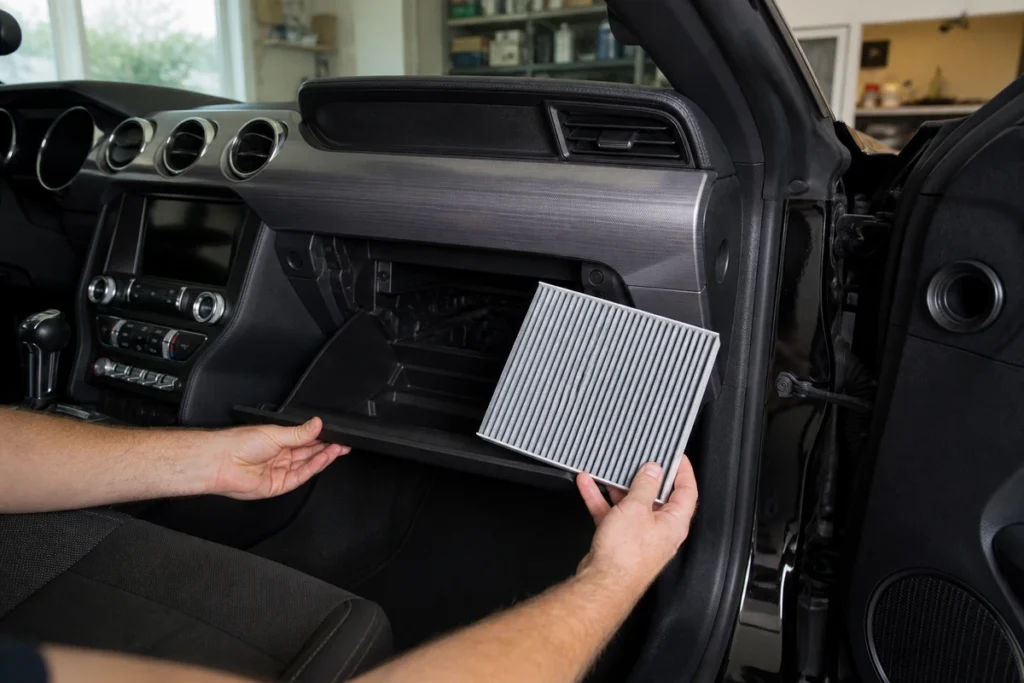
Ford’s current 2025 Mustang location guidance places the cabin filter behind the glovebox, with the access door above the passenger footwell under the instrument panel. Treat that as a location clue, not permission to force every glovebox down the same way. Generation, market and trim details can change the correct access procedure.
Read the manual for the exact model year before releasing stops, dampers or clips. Support the glovebox so its weight is not hanging from a small damper or wiring nearby. If a clip does not release with the documented motion, stop. A cracked hinge or broken soft-close damper creates a new repair without proving anything about airflow.
Read condition, fit and history together
If the filter can be viewed or removed by the documented method, preserve its orientation before moving it. Photograph the installed edge, airflow arrow if present and how the frame sits in the door. A filter folded at one corner, installed backward or poorly seated can allow bypass or obstruct the door even when the media itself does not look dramatically dirty.
Use side light to compare the pleats. Heavy debris, collapsed media, dampness, staining or a strong persistent odor are conditions worth recording. Do not judge only by color: filter media can darken gradually, and a clean-looking surface does not prove the full depth is clear. Do not shake or blow a dirty filter inside the cabin, and do not run the system with the filter removed.
Ford’s replacement guidance for the 2025 Mustang warns that incorrect handling can damage interior components, calls for replacement at the scheduled interval and says the system should keep a filter installed. It also notes that an unsuitable aftermarket filter can reduce filtration and climate-control performance. Confirm the exact part and interval by VIN, model year and owner information rather than copying another Mustang’s purchase.
Reassemble the access door and glovebox using the documented sequence, then repeat the same fan setting used at the start. The result belongs in one of three categories: airflow clearly improved; airflow did not change; or the glovebox/filter path could not be checked safely. Only the first suggests the filter was an important contributor. The other two preserve a clean handoff for further diagnosis.
If the main symptom is water after rain in a convertible rather than weak airflow, keep that investigation separate. Our Mustang convertible check after rain starts with water location and roof condition before operating the top. Mixing leak, odor and filter work in one session makes each result less reliable.
Finish with a small service record: date, mileage, fan setting, filter condition, part used if replaced and the before-and-after result. The point is not to make the cabin filter answer every HVAC complaint. It is to turn one accessible maintenance item into evidence that narrows the next decision without damaging trim or losing the original symptom.