
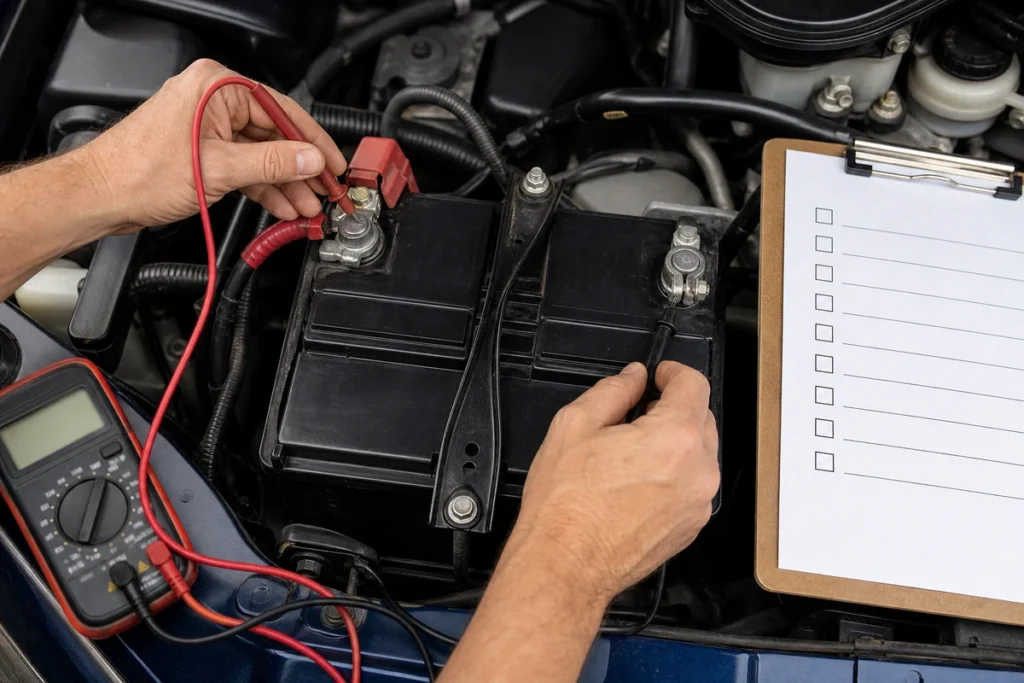
A Mustang that has been parked for weeks can still unlock, light the dash and sound completely normal while the 12-volt battery is carrying less reserve than the driver expects. The useful question is not simply “Will it start?” It is whether the car can wake up without erasing the clues that explain what the battery did during storage.
Begin with the ignition off, the key away from the car and every obvious load switched off. Do not reach for jumper cables first. Open the hood, look at the battery area and make a short garage record before changing anything: how long the car sat, whether a maintainer was connected, the ambient temperature and whether any low-voltage message appeared.
Ford’s 2026 Mustang owner’s manual treats storage longer than 30 days as a separate maintenance case. It recommends disconnecting the 12-volt battery to reduce system loads or using a trickle charger, then checking and recharging as necessary while keeping the connections clean. That is the baseline for this check: storage time matters even when the car looks undisturbed.
Record the condition before asking the battery to work
Use side light rather than a phone flash and inspect the top of the case, the hold-down, both cable ends and the surrounding tray. The battery should sit squarely. A loose hold-down, swollen case, dampness, cracked plastic or powdery buildup around a terminal is not a cue to “try it once.” Stop and arrange proper service, especially if the case is damaged or there is a strong sulfur-like odor.
Keep the visual check separate from cleaning. Photograph any deposit or displaced cover before touching it. Do not lean tools across the terminals, place metal parts on the battery or improvise a ground point. Eye protection and an uncluttered work area matter more than speed.
The first useful result is a condition record: what the battery and connections looked like before a charger, cable or ignition cycle changed the evidence.
Choose the next test from the evidence, not from habit
If the case and connections look normal, consult the manual for the exact model year before connecting a charger or meter. Battery location, approved ground points, battery type and battery-management instructions can differ. A generic video is not a substitute for the car’s documented connection points.
A resting-voltage reading can be one observation, but it is not a complete health verdict. Record when the car was last driven or charged and how long the battery rested before the reading. Surface charge, temperature and recent electrical activity can change what the number means. If you are not comfortable identifying the correct terminal and ground point, leave the meter disconnected and have the battery tested with equipment intended for the job.
- Normal-looking connections, no warning, confident restart
- Use the documented starting procedure once and watch the first few seconds carefully.
- Low-voltage message or weak electrical behavior
- Stop adding loads. Follow the model-year charging or assistance instructions rather than repeating start attempts.
- Damage, heat, odor, leakage or an unstable battery
- Do not charge or jump-start it in place. Keep the area ventilated and arrange professional inspection.
Make one controlled wake-up attempt
Before starting, close the doors, switch off climate control, lights and accessories, and make sure the transmission is in the required position with the parking brake applied. Keep people and loose objects clear of the engine bay. One controlled attempt is more informative than several rushed cycles.
Notice the sequence rather than chasing a single sound: how quickly the interior lights stabilize, whether the starter turns at its usual speed, whether the instrument cluster shows a low-voltage or charging warning and whether settings have reset. Do not hold the starter longer than the manual permits, and do not repeat the attempt if the electrical behavior becomes weaker.
If the car starts normally, that does not erase the storage history. Let the vehicle follow the operating guidance for its exact model and avoid switching on every accessory immediately. A charging-system warning while the engine is running requires attention; it is not proof that the battery merely “needs a drive.”
Leave the garage with a storage decision
End with one of three decisions: the car returned to service normally; the battery needs a documented charge and retest; or the car should stay parked for inspection. Write down the result rather than relying on how energetic the first crank sounded. A battery can start the car once and still have poor reserve.
If the battery has been disconnected or replaced, do not assume the job ends when the terminals are tight. Ford’s 2025 Mustang battery-sensor procedure documents a specific reset after a new battery is installed. Use the instructions for the exact car and battery specification; do not transfer a reset sequence blindly between generations.
If a warning or rough restart appears, preserve it. Photograph the message and note the time before clearing anything. The same evidence-first approach used in our Mustang check-engine-light field note applies here: changing the record too early makes diagnosis harder.
For the next storage period, choose the prevention method before parking: an appropriate maintainer, the manual’s disconnect procedure when suitable, or shorter inspection intervals. Record the date and method. The goal is not to make the battery invisible; it is to make the next wake-up predictable.