
A used Mustang can look convincing long before it proves that it is a good car. Fresh paint, a loud exhaust and the right badge are easy to notice; mismatched identity details, uneven tire wear and a reluctant cold start are quieter. The most useful inspection is therefore a sequence: establish what the car is, read its physical condition, then see whether its behavior supports the seller’s story.
Confirm the car before you inspect the story
Start with the VIN visible through the windshield and compare it with the door label and title paperwork. A smudged photograph is not enough. Enter the full number in the NHTSA VIN decoder while you are still with the car. Record the model year, engine and assembly information it returns, then compare those facts with the advertisement and the hardware in front of you.
This matters because Mustang trim names, appearance packages and later modifications are often mixed together in listings. A badge can be added in minutes. A decoded VIN gives you a fixed starting point, but it does not certify the condition of the engine, transmission or body. Treat it as an identity check, not as a substitute for the rest of the inspection.
Photograph the VIN locations and the odometer with the seller’s permission. If a number does not match, a label appears disturbed or the seller will not let you verify the paperwork, stop. That is not a negotiation point.
Arrive before the engine is warmed up
Ask in advance for the engine to be left cold. When you arrive, place a hand near the hood rather than on hot components and confirm that it has not recently run. A cold start shows behavior that can be hidden after warm-up: a weak battery, slow cranking, an unstable idle or smoke that clears once the engine has heat.
Before starting, look beneath the car and around visible fluid reservoirs. A clean driveway does not prove a leak-free car, and a dusty engine bay is not automatically bad. You are looking for patterns: fresh wetness, sprayed residue, a sweet coolant smell, recently wiped areas or fluid levels that do not agree with the seller’s maintenance story.
Turn the key or press the start button without touching the throttle. Listen through the full start and initial idle. One unfamiliar sound is not a diagnosis, especially on an engine with an aftermarket exhaust or intake. Note when it occurs, whether it changes with engine speed and whether warning lamps remain illuminated. A pre-purchase inspection by a qualified mechanic is the right place to identify the cause.
Read wear as a pattern around the car
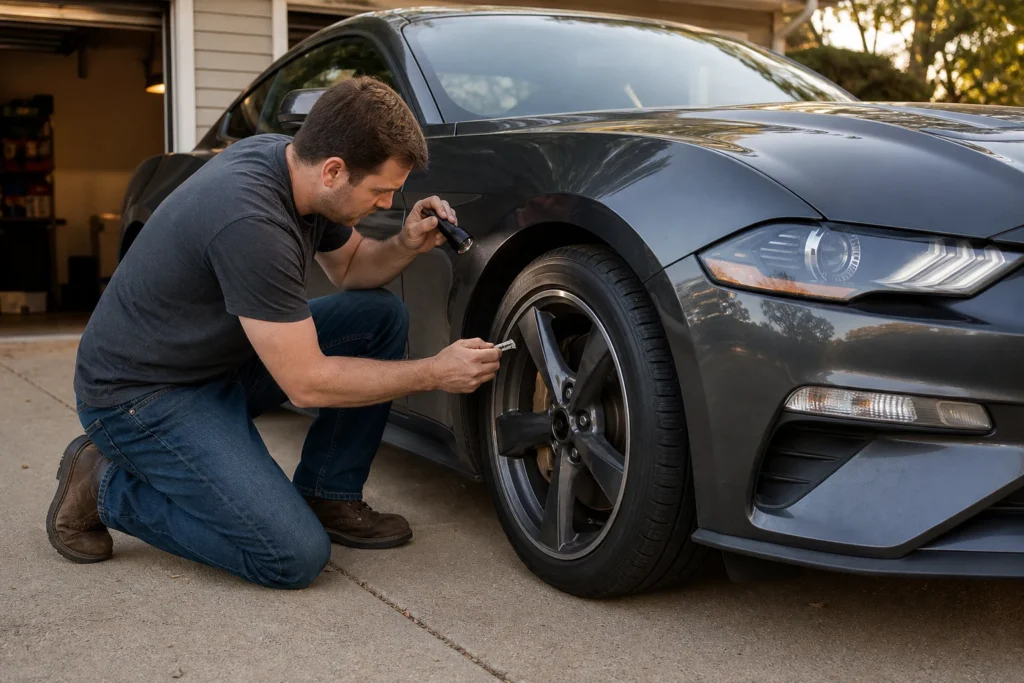
Use a flashlight and tread-depth gauge at the outer, center and inner sections of every tire. Compare left with right as well as front with rear. Uneven wear can point to alignment, inflation or suspension issues, while four different tire models may tell you that replacements were made one at a time. Check the date codes and sidewalls too; generous tread does not make an old, cracked tire ready for another season.
Look through the wheels at the brake rotors and calipers. Heavy scoring, a pronounced outer lip, fluid staining or one corner that looks unlike the others deserves a closer mechanical check. Do not crawl beneath an unsupported vehicle. From ground level, inspect what is safely visible: damaged pinch welds, fresh undercoating in a small isolated area, hanging panels and signs that exhaust or suspension parts have contacted the road.
Walk the body twice. On the first pass, view panel gaps and reflections from several angles. On the second, inspect paint edges, glass markings, lamps and fasteners. A repaired panel is not automatically a reason to reject the car, but inconsistent gaps or overspray should be reconciled with the disclosed history. The older the Mustang, the more important it is to separate normal cosmetic aging from structural or corrosion concerns.
Use the cabin as evidence, not scenery
With the ignition on and the engine off, confirm that the warning lamps perform their normal prove-out instead of remaining suspiciously dark. Test the windows, locks, mirrors, exterior lights, climate control, audio and seat adjustments. Move deliberately so you can write down a failure rather than discovering ten minutes later that you cannot remember which switch did what.
Wear should make sense as a group. A heavily polished steering wheel, sagging seat bolster and worn pedal pads beside an unusually low odometer reading are reasons to ask for documentation, not proof by themselves. Check for damp carpet and musty odors in the footwells and trunk. Inspect the spare-tire well where practical, because water traces or disturbed metal can reveal a story the visible cargo floor does not.
Modifications deserve their own inventory. Photograph the intake, exhaust, suspension, wheels, gauges, tuning devices and any non-factory wiring. Ask who installed each part and whether the original pieces and receipts remain. If the car’s appeal depends on a particular factory configuration, compare it with a well-understood baseline; even closely related Mustangs can be built for different use, as the contrast between the Mach 1 and GT350R in real use makes clear.
Make the test drive a controlled sequence
Agree on the route and insurance expectations before moving. Begin at parking-lot speed. Check steering effort in both directions, clutch take-up or automatic engagement, brake feel and the sound of the suspension over a small, ordinary surface change. A short low-speed loop can reveal more than an immediate full-throttle pull.
On a straight, legal road, notice whether the car tracks consistently and whether the steering wheel is centered. Apply the brakes progressively with space around you; do not create an emergency test on public roads. Watch the temperature and warning displays as the engine warms. Then include a steady-speed section and normal gear changes. The goal is repeatable behavior, not a performance demonstration.
Keep model expectations in context. A tire, suspension or gearing choice that makes sense on one Mustang can feel wrong on another. Likewise, the way an older pony car uses its space and torque differs from a newer platform; our look at 2009 Mustang GT and Challenger R/T priorities is a useful reminder that condition must be judged alongside the car’s original design.
History reports narrow the questions
Before paying, compare the seller’s documents with independent records. The FTC’s used-car buying guidance explains why a vehicle history report is useful but not a replacement for an independent inspection. A report can direct attention to title brands, mileage changes and recorded events; it cannot show every repair or tell you whether today’s clutch, brakes and tires are healthy.
For title and brand information, use an approved provider listed through the National Motor Vehicle Title Information System. Match the VIN exactly and save the report with the advertisement and your inspection notes. If the seller is a dealer, read the Buyers Guide on the car and understand which promises are written rather than implied.
Arrange an independent pre-purchase inspection even if your first pass goes well. Give the mechanic your list of observations instead of asking only whether the car is “good.” A focused request can include cold-start behavior, leaks, diagnostic codes and readiness monitors, brake and tire measurements, suspension play, evidence of collision repair and the quality of modifications.
Decide from a repair list, not the shine
After the drive, sort every finding into three groups: immediate safety work, near-term mechanical or maintenance work, and cosmetic preference. Price the first two groups using local parts and labor, then compare the total with other Mustangs of the same identity and condition. Do not treat modifications as automatically adding what they cost the previous owner.
A coherent car does not have to be perfect. Its VIN, paperwork, wear, behavior and history should tell compatible versions of the same story. When they do, the mechanic’s inspection can refine the decision. When they do not—or when the seller prevents ordinary verification—the most valuable result of the inspection is the confidence to walk away.