
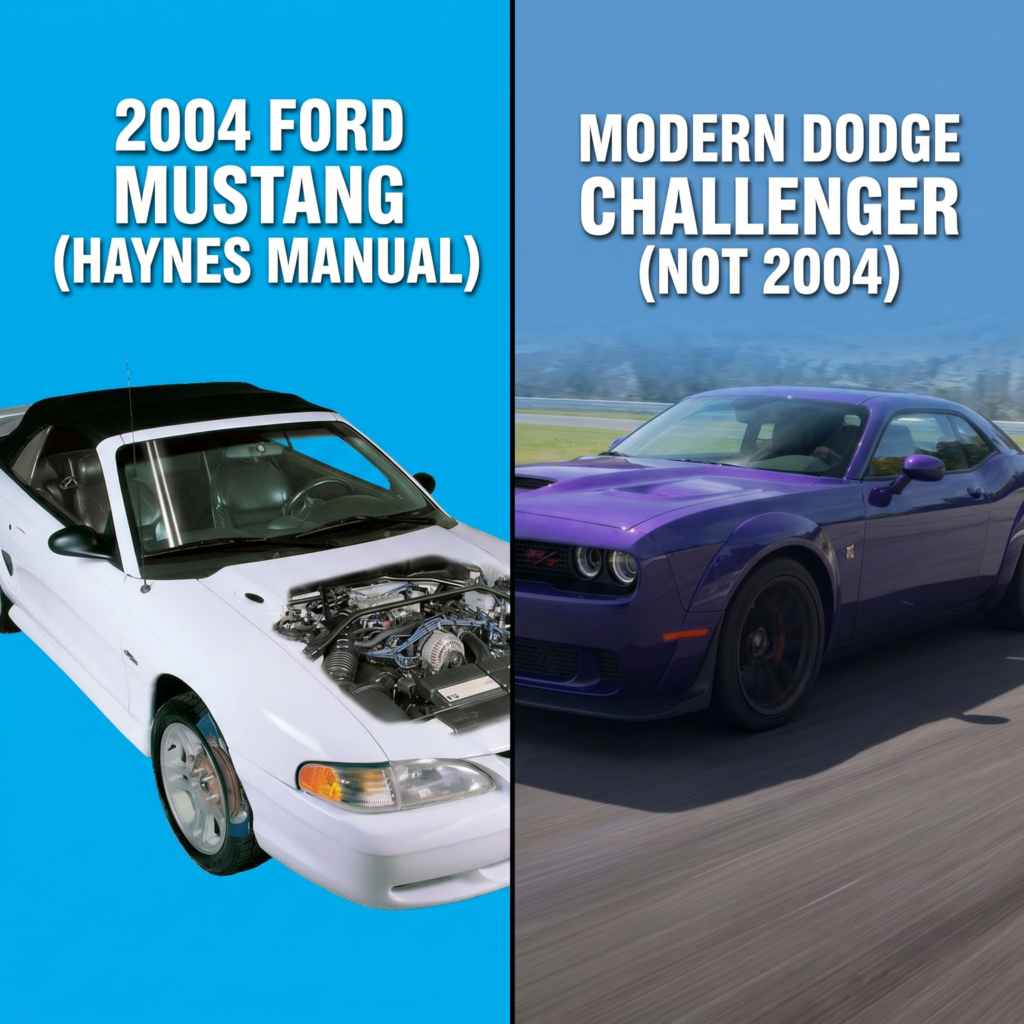
No modern 2004 Dodge Challenger exists, so a “2004 Mustang vs Challenger” comparison is either cross-era or a different Dodge coupe.
How to read “2004 Mustang vs Challenger” without getting misled
Most searches for “2004 Mustang vs Challenger” run into a simple calendar problem. A 2004 Ford Mustang exists (SN95/New Edge era). A Dodge Challenger, in the modern sense people mean on used-car sites, does not exist for 2004. Dodge brought the Challenger back for the 2008 model year.
So the comparison only becomes meaningful after choosing one of two real interpretations. Either the goal is an early-2000s Mustang versus the closest Dodge alternative available in 2004, or the goal is an older Mustang versus a later Challenger that shows up in the same budget range.
Three framing choices keep the comparison honest:
- Pick a time-correct Dodge substitute for 2004 (often an early-2000s Dodge coupe, not a Challenger).
- Pick a cross-era matchup on purpose (for example, a 2004 Mustang GT against a 2009–2014 Challenger R/T).
- Compare priorities, not badges: size, weight, sound, comfort, and running costs matter more than the model-year label.
That setup avoids the common forum trap of arguing specs that never existed in the same showroom year.
A quick orientation before any specs: what is actually being cross-shopped?
People rarely mean “same model year, same class, same mission” when they type Mustang versus Challenger. The shopping behavior is messier. One car is often lighter and smaller, the other tends to be larger and heavier, and the ownership experience can be a completely different decade.
Start with the known anchor. The 2004 Mustang sits at the end of the SN95 run (often called “New Edge”). Buyers find it because it is simple, widely supported with parts, and old enough that condition matters more than brochure numbers.
The Challenger that gets pulled into the conversation is usually the 2008-and-newer retro-styled coupe. In used listings it often appears as a V6 cruiser or as a V8 trim that emphasizes torque and highway feel. It also comes from an era with more safety structure and more electronics.
That age gap changes everything people ask about “Mustang vs Challenger size” and “Mustang vs Challenger weight.” It also changes what “Mustang vs Challenger price” means, because price depends on mileage, rust, accident history, and how modified the car is.
One more practical note. When shoppers say “Mustang vs Challenger specs,” they often mix trims. A V6 Mustang against a V8 Challenger is not apples-to-apples, and it distorts expectations about speed, sound, and fuel use.
Two fair comparison paths that match real buyer intent

There are two ways to make the matchup fair enough to be useful. Both can answer the same buyer questions, but they do it with different assumptions.
Path 1: Time-correct 2004 comparison. This keeps the calendar honest. A 2004 Mustang is compared to a Dodge alternative that a buyer could actually buy in 2004. The “Challenger” part becomes shorthand for “a Dodge muscle-coupe vibe,” not the literal model. This path is best for readers trying to understand early-2000s design priorities: smaller footprint, fewer driver aids, and simpler drivetrains.
Path 2: Cross-era used-market comparison. This accepts that shoppers cross-shop by budget, not by model year. A clean 2004 Mustang (often a GT) can land in the same money zone as an early modern Challenger (often 2009–2014). This path is best for questions like “Mustang vs Challenger comfort,” “Mustang vs Challenger sound,” and daily livability.
Both paths need clear trim matching. V6-to-V6 and V8-to-V8 comparisons keep expectations realistic. So does admitting that curb weight, gearing, and tire width can matter as much as peak horsepower.
Choosing comparison criteria that matter in real driving
Forum debates often jump straight to speed. That is understandable, but it misses the parts that decide whether the car still feels right after a month of commuting and weekend errands.
For a Mustang versus Challenger discussion, the most decision-relevant criteria tend to cluster into five buckets:
- Size and Visibility: exterior length and width affect parking, garage fit, and blind spots. This is where “Mustang vs Challenger size” is felt every day.
- Weight and Traction: heavier cars can feel planted on the highway but ask more from brakes and tires. That is the lived meaning of “Mustang vs Challenger weight.”
- Power Delivery and Sound: torque curve, exhaust design, and gearing shape “Mustang vs Challenger sound” and how fast the car feels at normal speeds.
- Comfort and Daily Use: seat design, ride compliance, cabin noise, and rear-seat usefulness decide whether “muscle car” is a weekend toy or a daily driver.
- Ownership Reality: age-driven maintenance, parts availability, and modification history. A 2004 car adds rubber, seals, and suspension wear to the equation.
Safety and technology also belong on the list, but they behave differently across eras. A 2008+ Challenger comes from a period when side airbags and electronic stability control became more common in the market. A 2004 Mustang can be simpler to diagnose, but it will not mirror later-era crash structures or driver assistance.
For readers who want an official baseline on safety equipment concepts and how to interpret them, the U.S. National Highway Traffic Safety Administration has model-level information and explanations of safety ratings and features at NHTSA vehicle ratings and safety information.
Power delivery and “speed” feel: why the numbers don’t tell the whole story
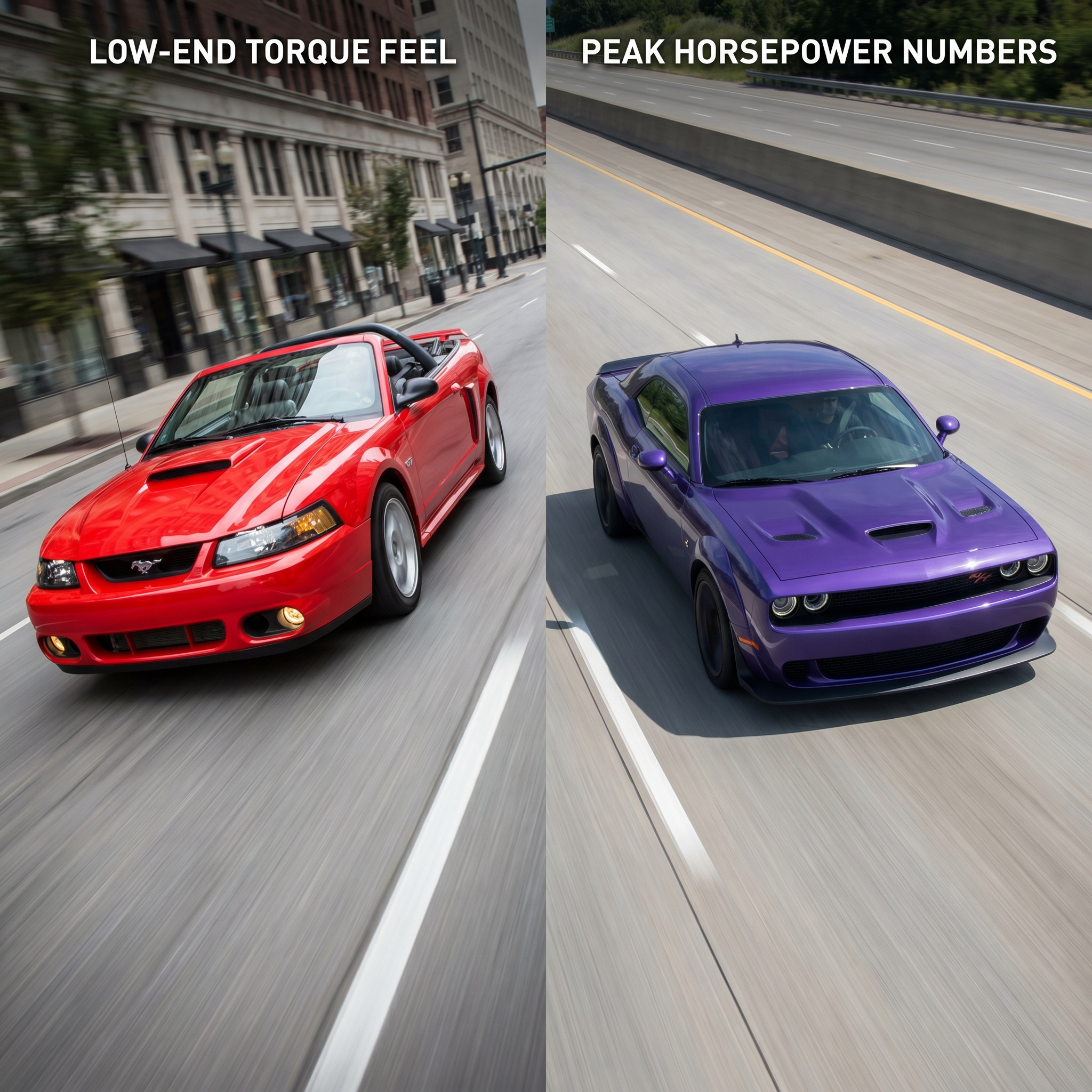
In a “2004 Mustang vs Challenger” debate, speed talk often collapses into peak horsepower. Daily driving doesn’t work that way. Curb weight, gearing, and the first 30–60 mph matter more than a brochure headline.
A 2004 Mustang GT uses a 4.6L 2-valve V8 rated around 260 hp and 302 lb-ft. The base 2004 V6 Mustang is far lower, around 190 hp and 220 lb-ft. Either way, the Mustang starts from a smaller, lighter platform than an early modern Challenger, so throttle response can feel more immediate even when the absolute power isn’t dramatic.
On the Challenger side, the common cross-era trims span two different engines. Early cars offered a 3.5L V6 (typically 250 hp), later ones moved to the 3.6L Pentastar V6 (305 hp). The V8 reference point in the same used-market conversation is often the 5.7L HEMI, rated 372 hp in 2009 and 375 hp by 2011. Those numbers look decisive, but the Challenger also carries more mass, and that changes how quickly it picks up speed at normal road speeds.
Gearing and transmission choices shape the feel. Many 2004 Mustangs run a 5-speed manual (T-45 or TR-3650 depending on trim) or a 4-speed automatic. Early Challengers often pair the 5.7L with a 5-speed automatic, while later cars can have a 6-speed manual or 5-speed automatic depending on year and trim. A tall first gear and a heavy car can make “fast on paper” feel calmer at low speed, then stronger once rolling.
So the practical lens for “Mustang vs Challenger speed” is simple: compare V6 to V6 or V8 to V8, then judge how much of the power is usable without constant traction drama. Tires and differential setup matter as much as the engine label.
V6 Mustang vs V6 Challenger and V8 Mustang vs V8 Challenger: trim matching that stays honest
Trim matching is where most online arguments go off the rails. The two cars can be compared fairly, but only if the pairing makes sense.
For a V6-to-V6 cross-shop, the mismatch is often not horsepower but mission. A 2004 V6 Mustang tends to be a simpler, lighter coupe with fewer comfort and safety layers. A V6 Challenger from 2009–2014 usually aims at relaxed torque, a larger cabin, and highway cruising. That difference shows up in how often the car feels “busy” in town versus “settled” at 70 mph.
For a V8-to-V8 comparison, the gap is more about architecture than badge pride. A 2004 Mustang GT’s 4.6L is a smaller-displacement V8 with a different character than the 5.7L HEMI in an R/T. The Mustang can feel more eager to rev and more compact in traffic. The Challenger often feels like it has a broader shove in the midrange and a calmer cadence at speed, even when the driver isn’t chasing redline.
Transmission choice changes that contrast. A manual makes either platform feel more alert, but it also exposes gearing decisions. A heavy coupe with tall gearing can feel less dramatic leaving a stoplight than expected. A lighter car with shorter gearing can feel quicker than its horsepower suggests, especially in the 20–50 mph band where most passing happens.
One more realism check: modifications distort comparisons. Intake and exhaust changes, gear swaps, and tuning can move the “feel” more than people expect. A lightly modified 4.6L with shorter rear gears can change the whole story, while a Challenger with wide rear tires and a limited-slip differential can put down power in a way a stock setup may not.
That’s the clean way to keep “Mustang vs Challenger specs” from turning into a fantasy draft. Match the engine class first. Then compare how the car behaves in the speed range that gets used.
Size, weight, and the way they steer: what “Mustang vs Challenger length” changes on the road

“Mustang vs Challenger size” isn’t just about parking. It changes how the car places itself on a lane, how quickly it rotates into a turn, and how much confidence it gives in tight spaces.
As a rough anchor, a 1999–2004 Mustang coupe is about 183 inches long with a 101.3-inch wheelbase. A 2008–2014 Challenger is closer to 197 inches long with around a 116-inch wheelbase. That wheelbase gap alone tells a lot. The longer car tends to feel more stable on the highway and less reactive to small steering inputs. The shorter car can feel more agile in quick transitions, but it can also feel busier on broken pavement.
Weight is the other half of “Mustang vs Challenger weight.” A 2004 Mustang GT is often in the mid-3,300 lb range depending on body style and transmission. Many early modern Challengers are well into the 4,000 lb range in V8 trims. That extra mass needs more brake and tire to feel sharp, and it can make repeated hard stops or tight-road driving more demanding on consumables.
Steering and chassis tuning also reflect the era. The Mustang’s front end and solid rear axle bring a certain simplicity and a specific kind of feedback. The Challenger’s modern chassis and independent rear suspension (on the LX-derived platform) usually deliver a different ride and more composure over mid-corner bumps. Neither approach is automatically “right.” They just ask for different expectations.
For daily livability, the size difference becomes a habit. The Challenger’s longer hood and wider body can require more care in tight lots and narrow garages. The Mustang’s smaller footprint usually makes it easier to thread through city driving, but older visibility and lighting performance can depend heavily on condition and previous owner choices.
This is where “Mustang vs Challenger looks” sneaks into function. Retro styling often means high beltlines and smaller glass. That can add blind-spot management work in real traffic, regardless of how strong the engine feels.
Ownership reality for older cars: age, parts support, and what tends to end the honeymoon
Cross-era comparisons often ignore the biggest variable. Time. A 2004 Mustang is old enough that rubber, seals, and suspension wear become routine, not rare.
Plan on age-driven work even on a “nice” example. Hoses, vacuum lines, bushings, ball joints, shocks or struts, and engine mounts can all be at the end of their service life. Cooling system attention is common on older V8 and V6 cars alike. Electrical issues can be as simple as grounds and connectors, or as annoying as intermittent sensors. None of that is exotic, but it’s time-consuming if the car hasn’t been kept up.
The early modern Challenger brings a different kind of risk. It’s newer, but it has more modules, more networked electronics, and often more complex packaging. That can make diagnosis more dependent on scan tools and correct procedures. It also means small issues can cascade into bigger ones if a previous owner chased a symptom with parts swapping.
Service information quality matters when a car is old or heavily used. A repair manual doesn’t replace a factory service manual, but it can help a buyer understand what “normal” looks like when inspecting common wear points. For readers who want a reference book for the SN95 era, Ford’s coverage is captured in the Ford Mustang 1994 Thru 2004 Haynes Repair Manual. For the modern-era platform that includes the Challenger nameplate, the Chrysler 300 (05-18), Dodge Charger (06-18), Magnum (05-08) & Challenger (08-18) Haynes Repair Manual is the relevant counterpart.
Reliability talk also needs a mileage lens. A 2004 car with 160,000 miles is not the same proposition as one with 70,000 miles, even if both “run fine” on a short test drive. A 2009–2014 Challenger may hide wear too, but the baseline age is different, and so is the likelihood that original components are still within their intended window.
The clean comparison point for “Mustang vs Challenger price” is not a single number. It’s total ownership cost over the first 12 months: catch-up maintenance, tires, brakes, insurance, and the cost of undoing questionable modifications. That’s where the older Mustang can surprise people, and where the heavier Challenger can surprise them too.
A decision lens for “2004 Mustang vs Challenger”: decide by use, not by forum bragging rights
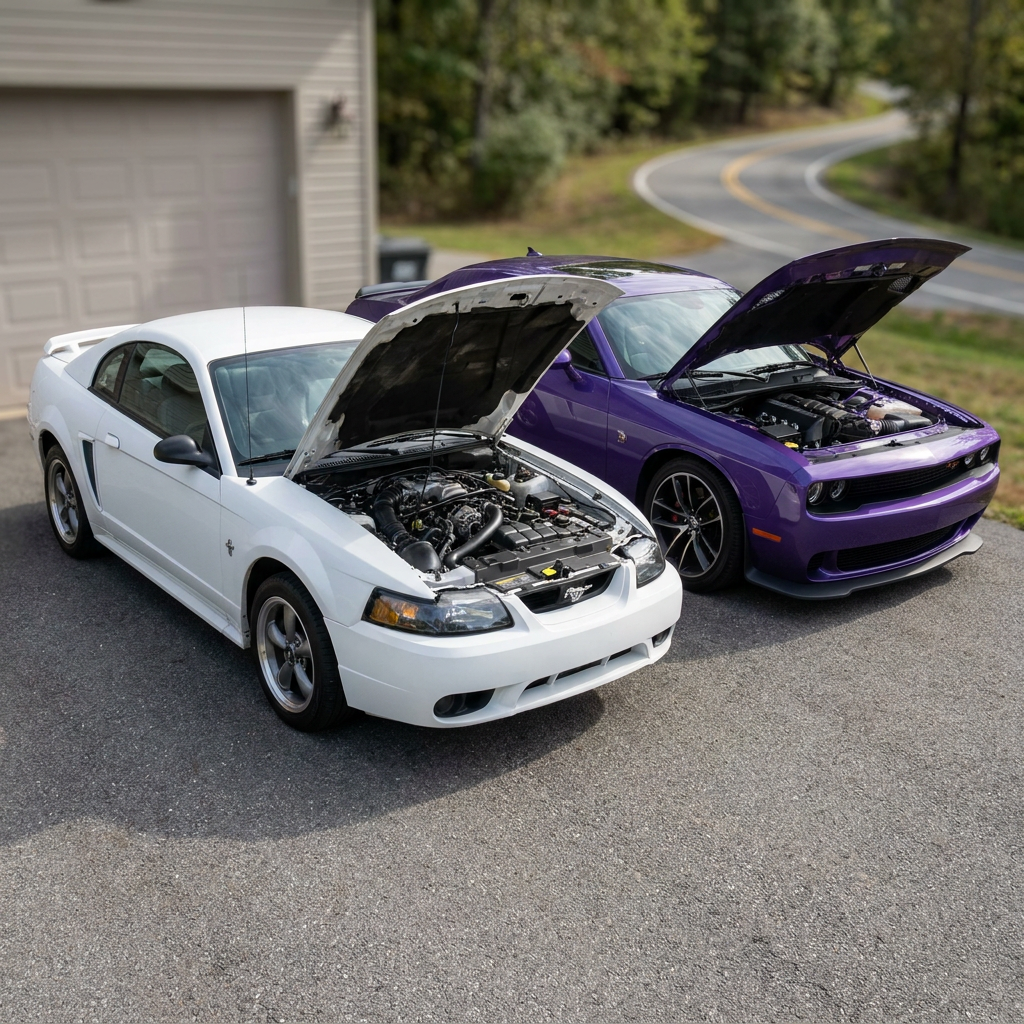
The cleanest way to settle a “2004 Mustang vs Challenger” decision is to stop treating it like a single matchup. It’s two different purchase problems that share a badge-shaped vibe. One path is a simple, older coupe with fewer layers between the driver and the road. The other path is a newer-era muscle coupe that trades some immediacy for space, stability, and a more modern crash-and-electronics era.
Start with the week-to-week use case. Short urban trips, tight parking, and back-road driving reward a smaller footprint and a lighter feel. Long highway stretches, wider lanes, and relaxed cruising reward wheelbase, cabin width, and a calmer ride. That’s the real meaning behind searches like “Mustang vs Challenger comfort” and “Mustang vs Challenger looks.” The styling matters, but the packaging and the sightlines matter more after the novelty wears off.
Then get honest about how the car will be used. A rear-wheel-drive coupe that’s driven year-round in snow-belt conditions becomes a tire choice and corrosion-prevention project, regardless of brand. A weekend-only car shifts the math toward simplicity and the ability to park it without worrying about every mile. And if the plan includes modifications, the most valuable trait is not peak output. It’s the quality of the starting point and the ability to undo someone else’s shortcuts.
One confident position belongs here. A cross-era comparison only stays fair when trims are matched. V6-to-V6 and V8-to-V8. Anything else turns into a moving target and the “Mustang vs Challenger specs” conversation becomes noise.
Used-market reality check: how to test-drive so “Mustang vs Challenger price” stays realistic
Price talk needs a process, not a number. A clean-looking listing can hide the costs that hit in the first 30 to 90 days. That matters more on an older car, and it still matters on a heavier, newer coupe. Budget decisions get clearer when the test drive is structured around wear, not excitement.
A short loop doesn’t work. A useful drive is at least 20 minutes and includes a cold start, a few hard stops, a steady 60–70 mph cruise, and a rougher road segment. Those four moments expose most of what changes ownership costs.
- Cold Start and Idle: listen for ticking, belt noise, or hunting idle. Watch for warning lights that come and go after a few seconds.
- Braking From Speed: repeated stops reveal pedal pulsation, pull, or a soft pedal. Heavier cars ask more from brakes, and that shows up in cost.
- Steering and Straight-line Tracking: a car that wanders or feels vague can be alignment, worn front end parts, or uneven tires. None are deal-breakers, but they change the “price” story.
- Transmission Behavior: check for delayed engagement, flare between gears, or harsh shifts. Automatic behavior is often the most expensive surprise.
- Noise Over Bumps: clunks and rattles often point to bushings, end links, ball joints, or mounts. On an older chassis, that’s common catch-up work.
Paperwork is part of the drive. Service receipts matter more than a shiny engine bay. A folder showing cooling-system work, suspension refresh, and brake history can be worth more than a low-mileage claim with no proof.
Rust deserves a dedicated look. Check pinch welds, floor pans, and rear suspension mounting areas. A quick flashlight inspection under the car can save months of regret. For general guidance on rust, recalls, and model-level safety information, the National Highway Traffic Safety Administration maintains a searchable database at NHTSA recalls lookup.
When the comparison stops being about speed and becomes about living with the car
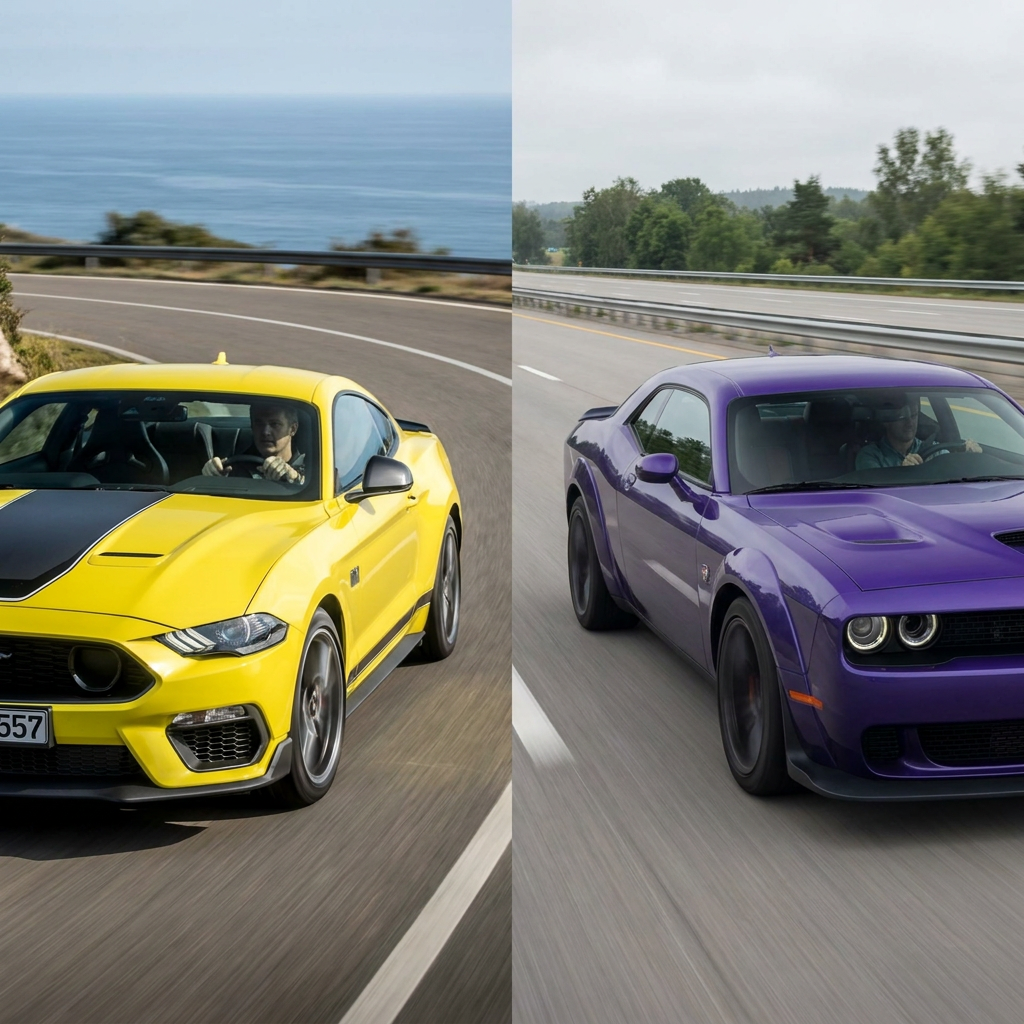
Most “Mustang vs Challenger speed” arguments fade once the car is used for errands, commutes, and the occasional long drive. The difference that remains is character. A smaller, lighter coupe tends to feel more alert at legal speeds. A larger, heavier coupe tends to feel more planted and less busy on the highway. Neither trait is a trophy. It’s a preference that shows up every day.
Comfort isn’t only seat softness. It’s also cabin noise, ride compliance, and how much the car asks from the driver in traffic. A car that feels exciting on a five-minute blast can feel tiring if it’s loud, stiff, or constantly hunting for traction. That’s why “Mustang vs Challenger sound” is a double-edged question. Exhaust note is fun. Drone on a 45-minute drive isn’t.
Looks are similar. “Mustang vs Challenger looks” is personal, but there’s a practical side. Retro shapes often bring higher beltlines and thicker pillars. That changes lane-change confidence and parking ease. Visibility isn’t a small detail in daily use. It’s part of fatigue.
Then there’s the social reality of modifications. An older Mustang with clean, reversible changes can be straightforward to live with. A heavily modified car with unknown tuning and cut wiring can turn simple diagnosis into guesswork. A newer-era Challenger can also be modified into a question mark, but the electronics and modules raise the stakes if previous owners chased problems with random parts.
A fair end point for the comparison is simple. Choose the driving experience that matches the most common miles. Weekend fun miles and short trips point one way. Long commutes and frequent highway time point the other way.
Where this choice fits, and where it doesn’t
This comparison fits drivers who are cross-shopping by budget and feel, not by model year. A smaller, older coupe makes sense when parking space is tight, plans include hands-on maintenance, and a lighter, more direct driving character matters more than cabin space.
It won’t fit buyers who want a single, era-correct head-to-head with equal safety tech and equal age-related risk. It also won’t fit anyone expecting a low-effort experience from a 2004 car or expecting a larger coupe to feel nimble in tight streets.
Frequently asked questions
Why is “2004 Mustang vs Challenger” a confusing comparison?
The modern Dodge Challenger returns for the 2008 model year, so “2004” forces a cross-era comparison or a different Dodge alternative. Clarity comes from stating the exact years and trims being compared.
In a 2004 Mustang vs Challenger cross-shop, what should be matched first?
Match engine class and intent. V6-to-V6 and V8-to-V8 comparisons keep expectations realistic for acceleration feel, running costs, and traction behavior.
Does “Mustang vs Challenger size” matter if the car is only a weekend toy?
Yes, because size still affects garage fit, parking stress, and visibility. Weekend-only use lowers mileage pressure, but it doesn’t change how the car fits into real spaces.
Is “Mustang vs Challenger price” mostly about the purchase number?
No. The first-year costs often decide the real price, especially with tires, brakes, suspension wear, and deferred maintenance. A structured test drive and service records usually predict those costs better than a low asking price.
Three things to keep in mind
“2004 Mustang vs Challenger” is only fair after choosing a time-correct substitute or a deliberate cross-era matchup.
Trim matching keeps the comparison honest, especially V6-to-V6 and V8-to-V8.
Daily livability, maintenance history, and space matter as much as straight-line pace.